LAST month was the third-warmest December of the 21st century and 58% drier than average, despite the torrential rain and flash floods across the country over the middle of the month, according to the State meteorological agency, AEMET.
Temperatures across Spain were 0.6ºC higher than the norm for the last month of autumn and first 10 days of winter with an average nationwide of 8.6ºC, as opposed to the typical 8ºC seen between 1981 and 2010.
This encompasses land-locked, northern and mountainous regions where it is not unusual for winter temperatures to fall to -12ºC even in daytime in December, as well as Mediterranean and south coast territories where nights are often in single figures but brief highs of around 17ºC or 18ºC are common for an hour or two over the middle of the day.
In fact, December 2016 was the 12th warmest final month of the year since 1965 and, so far this century, only December 2002 and 2015 saw the mercury rise higher.
Typically cold regions such as Galicia, Cantabria, Asturias, northern Castilla-La Mancha, Castilla y León, the Pyrénéen provinces and the central and western parts of Andalucía saw temperatures ranging from 'warm' to 'very warm', according to AEMET, although western Castilla y León and most of the Ebro Valley in the north-east were 'cold' or 'very cold'.
Warm and very warm temperatures were recorded in the Balearic and Canary Islands, although these regions were cold at high altitudes.
Some areas saw figures of up to 2ºC higher than average on the thermometers, including eastern Catalunya, central Spain, the Pyrénées and the Cantabrian Sea coast.
Colder-than-usual parts of the country generally owed their lower temperatures to persistent freezing fog, including the provinces of Huesca and Zaragoza in Aragón, and Lleida in Catalunya.
The highest temperatures across the country in December were recorded at the beginning of the month, mainly in the Canary Islands, where the mercury soared to 28.3ºC on the island of Fuerteventura on December 2 and to 27.6ºC in Gran Canaria on December 3, both figures taken from weather stations at their main airports.
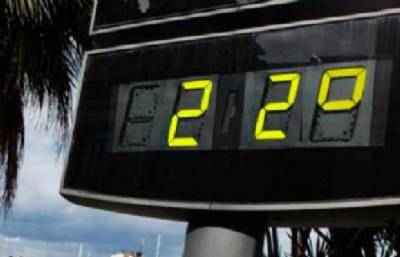
The highest temperature recorded on the mainland was in Jerez de la Frontera (Cádiz province) on December 6, at 22.2ºC, and unusually, in Santander (Cantabria), which reached 22ºC (pictured) on December 5.
The coldest parts of Spain were Molina de Aragón on December 30, which plummeted to -11ºC overnight, and on the last night of the year in Burgos and Valladolid, which sank to -8.2ºC and -7.3ºC respectively.
Although December was 58% drier than average nationally, with a typical 48 litres of rain per square metre (4.8 centimetres, or just under two inches) throughout the entire month compared with the usual 82 litres (8.2 centimetres, or slightly over three inches), the south coast and Mediterranean experienced four times the usual level of rainfall for the final month of the year.
Between Friday, December 16 and Thursday, December 22, record amounts of rain swept across the Balearic Islands, Murcia, Valencia, southern Catalunya and eastern Andalucía, with another episode of flash floods hitting Málaga and Cádiz on December 3 and 4.
Elsewhere in Spain, it hardly rained at all in December, AEMET reveals.
Over the month as a whole, in excess of 400 litres per square metre of rain (40 centimetres, or 16 inches) was recorded in the worst-hit areas, compared with less than five litres (half a centimetre, or a quarter of an inch) in Burgos (Castilla y León) and Huesca (northern Aragón).
On average, outside of the December flood zones, it rained 75% less than usual in the rest of the country, AEMET reports.