POLICE in Spain have detected hauls of 'bushmeat' on Spanish territory, smuggled in through Madrid's Adolfo Suárez-Barajas airport – raw toucan, monkey and armadillo meat designed for human consumption with no health and safety or hygiene measures or supervision.
Already, Switzerland, France and the USA had reported the presence of bushmeat, but until now, none had been intercepted at international borders.
This week, however, the Guardia Civil and its environmental arm, SEPRONA, uncovered a suitcase filled with dead, skinned and filleted wild animals travelling in on a flight from the former Spanish colony of Equatorial Guinea.
It had been brought in by a passenger from Malabo, who caught a connecting flight in Casablanca (Morocco) and was due to take another in Madrid, the end destination being Bilbao in the Basque Country.
But when the traveller realised the police were on her trail, she dumped the case at Madrid-Barajas.
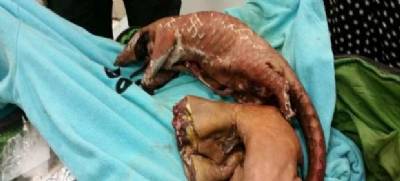
Airport police inspected the case and found the cuts of meat hidden among clothing.
They included at least two pangolins – a type of armadillo or scaly anteater from the manidae family – and another species which could have been a Zanzibar red colobus monkey.
These creatures are part of the traditional diet in some African countries, but all food imports – especially raw meat – has to go through stringent health and hygiene controls to enter Europe, and the animals in question are endangered species protected by the international CITES treaty.
The owner of the suitcase was found quickly, because she had checked the suitcase in and her name was recorded on the system.
This is not the first case in Europe – recently, a random check on luggage carried by passengers on various flights at Paris' Charles de Gaulle airport uncovered 134 suitcases containing 188 kilos of raw bushmeat.
Authorities in the European country have also seized two consignments of dead, skinned and filleted parrots, alligators, toucans and monkeys – over half a tonne of bushmeat – in French Guayana, which is politically considered to be part of France, having been brought in from neighbouring Suriname.
The problem is on the increase because of residents in European countries who come from nations where bushmeat forms part of their normal diet bringing cases of it home after visiting their families in their native lands – a much larger issue for France, since a high number of its ex-colonies are in Africa and migration between these one-time national networks is common.
Without the requisite hygiene and heatlth checks, consumers can catch diseases carried by the animals, and these may be transferred to other residents.
Police say it is often difficult to even identify the species in question, given that they are filleted and smoked in many cases, ready for consumption, so they sometimes have to resort to DNA testing at great cost to the State.
Other than the recent case at Madrid-Barajas, the issue has not had a great impact in Spain as yet, police say.