
Movístar launches phone App to prevent car theft
NATIONAL telecomms giant Telefónica has created an anti-car theft phone App for less than the cost of a glass of wine per month.
Sign in/Register
Looking for the Professionals/Advertiser Login?
By Signing up you are agreeing with our Terms and Privacy Policy.Forgot your password?
Feedback is welcome

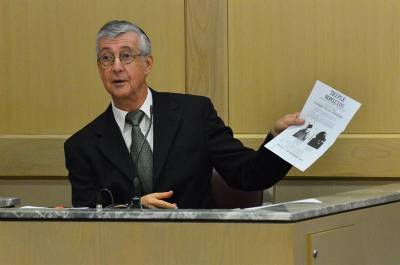
Contracted by Ibar's defence, Fischer (pictured) says that 'intentionally or not', eye-witness Gary Foy – a neighbour of one of the victims – was 'pushed' into indicating the Spaniard in an identity parade.
Following a long-winded and drawn-out process in which the prosecution made every effort to prevent Fischer from presenting his findings aimed at invalidating Foy's testimony, the psychologist managed to get into the dock before judge Raaj Singhal in the court of Fort Lauderdale, located 48 kilometres north of Miami, Florida.
Ibar, 45, was present and accompanied by his father Cándido, his wife Tanya and his brother Michael (the latter two pictured below right with Ibar's lawyer) along with other family members.
Last year, Florida Supreme Court overturned a verdict passed in the year 2000 condemning Ibar to death for three murders, claiming the evidence against him was 'scarce' and 'weak', ordering a retrial.
Fischer, professor at Florida International University, answered questions by Ibar's lawyer Benjamin Waxman who is attempting to convince Singhal to disregard Foy's statement.
Next, Fischer was interrogated by prosecutor Chuck Morton who had been involved in the original trial 17 years ago.
Morton claimed Fischer's arguments were unscientific, and questioned the angle from which he had examined the 'facts'.
Pablo Ibar, nephew of Spanish boxer José Manuel Ibar – known as 'Urtain' – has joint Spanish-American nationality and has been on Death Row for 16 years.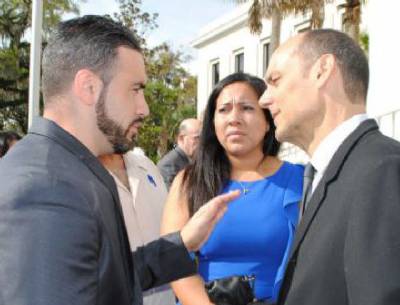
He is accused of murdering nightclub owner Casimir Sucharsky and two models, Sharon Anderson and Marie Rogers in 1994 after Foy, who lived next door to Sucharsky at the time, identified him as one of two men seen leaving the club boss' house and getting into his car the day after the murders.
Post-event discussion, according to Fischer, included the police giving Foy information which 'influenced' him to point to 'a specific suspect', and led to recall of false memories.
Foy was not present at this week's hearing.
The identity parade, both in person and via photographs, was conducted in a way which 'went against procedural norms', the psychologist claimed.
Morton, who interrupted Fischer and Waxman several times, used descriptions such as 'interpretations' and 'speculations' for both men's arguments.
Among the people who took part in the identity parade along with Ibar were three men aged under 20 – and Ibar was 28 at the time of his conviction, and 22 when the murder happened – which Fischer said was a 'recipe' for 'inducing' the witness to indicate the wrong suspect, since the two individuals seen leaving Sucharsky's house and driving away in his car were definitely men, whilst three of those in the line-up were barely more than boys.
Also, Foy was shown pictures of Ibar both with and without a beard, which would also have 'contributed to creating' an identification, says the psychologist.
Foy and other witnesses were shown footage from a CCTV camera outside Sucharsky's house – the only incriminating evidence in the case – which Waxman has described as 'blurred, grainy and with no sound'.
Also, the DNA, pieces of human hair and fingerprints found at the scene – the only other clues available for identifying the killer or killers – did not match those of Ibar.
The Spaniard has spent a third of his life in on death row and half his life in prison, and has always insisted he is innocent.
According to The Innocence Project in the USA, over 214 men have been convicted of crimes they did not commit through incorrect eye-witness testimony.
Among these was Ronald Cotton, incorrectly identified by student Jennifer Thompson as the rapist who held her at knifepoint.
Cotton was jailed and sentenced to death by electric chair, and Ms Thompson even wanted to flick the switch herself.
But in 1995 – 11 years on – DNA evidence revealed the identity of Jennifer's rapist, and it was not Ronald Cotton.
She begged Cotton for forgiveness when he was released, and they have since become close friends who have given college lectures on the dangers of relying upon eye-witness testimony for convicting criminals, and even written a book together on the subject, called Picking Cotton.
NATIONAL telecomms giant Telefónica has created an anti-car theft phone App for less than the cost of a glass of wine per month.

A MAN declared dead at his home in the province of Tarragona was on his way to the funeral parlour when he turned out to be alive, according to police sources.

A SICILIAN mafia 'godfather' who had been on the run for 20 years was captured in Madrid thanks to a photo on Google Maps, police say.

A NEW child protection law named after a British musician living in Spain has been approved in Congress and is set to be signed off by the Council of Ministers on Tuesday, June 8.