
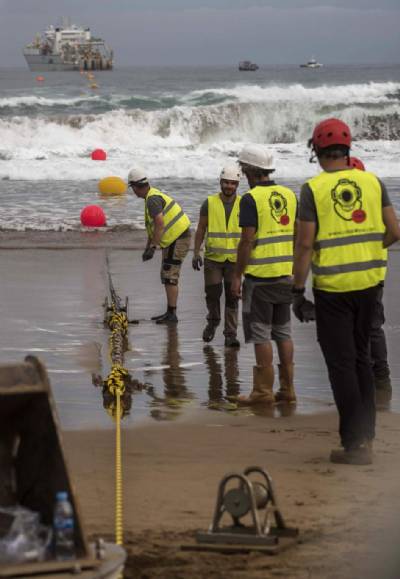
The Marea high-speed cable being laid under the Atlantic by Facebook, Microsoft and Telefónica in order to link the USA and Europe arrived at Arritera Beach in the Basque town of Sopelana on Tuesday.
According to Microsoft, "MAREA will be the highest-capacity subsea cable to ever cross the Atlantic – featuring eight fiber pairs and an initial estimated design capacity of 160Tbps [TeraBits Per Second]." That is 16 million times faster than a standard home internet connection.
The Spanish Environment Ministry has granted a 25-year concession to operate and manage the cable to Telxius, a unit of Telefónica. They will control 27,861 square metres of public domain spread over land and sea. The telecoms infrastructure firm will pay the Spanish state a fee of around €1 million for occupying that space throughout the concession period.
The undersea cable measuring 6,600 km in length will be the first one ever to connect the USA (via a hub in Virginia Beach, North Virginia) to southern Europe. There are plans to extend the cable at a later date into the Near East, Africa, Asia and Latin America.
During the anchoring ceremony in the coastal town of Sopelana, Facebook spokesman Kevin Salvadori highlighted his company's quest for a "more open and connected" world, in which people can share "experiences in any corner of the world".
He also underlined the "unique" and "excellent" collaboration with Telefónica that has made the Marea project possible, emphasising their "experience and prestige", and stressed the importance of cooperation in making projects like this happen.
"We can make the global Internet grow, make these networks more profitable and the world a more open place", he concluded.
For his part, Microsoft's network operations director, Frank Rey, said that the inauguration of the southern cable would cover demand from customers with next generation connections "speeding up communications". Rey pointed out that "our daily lives depend on the Internet", and added that the Marea cable will be "key" to cloud technology. "It is a new milestone in Internet infrastructures", he said.
Telxius cable's operations director, Rafael Arranz, told reporters how proud he was to bring an infrastructure such as this to Spain. "This is an historic occasion and the result of many years' work", he said, adding that thanks to this project "Spain is the anchor point for one of the most important underwater cables in the world".
The Sopelana anchor is connected to an existing corridor of European fibre optic networks linking cities like Paris, Frankfurt, Amsterdam and London.