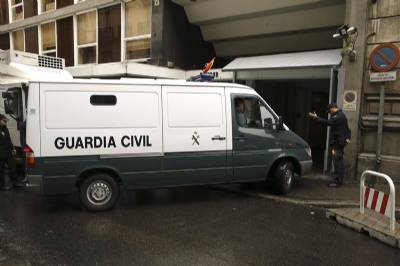
A MASSIVE car-cloning racket has been broken up with 19 arrests and five other individuals under investigation – one of whom is a civil servant from an undisclosed provincial government in Spain.
So far, 85 vehicles are known to have been stolen, cloned and their ringers sold across Europe, bringing the gang profits of over €1.5 million.
Thought to be the biggest car-trafficking network ever uncovered, its members were not only Spanish but also Greek, Estonian, French, Romanian, Polish, Portuguese, Brazilian and Bulgarian.
A probe was launched after a man from Madrid told police last September that he kept getting speeding fines for places he had never been.
He said the photos sent with the fine notices showed a car that 'looked just like his'.
Guardia Civil officers discovered that two cars of the same make, model and registration number were in circulation at the same time.
The ringer was driven by a Bulgarian man with an extensive criminal record for car theft, forgery and handling stolen vehicles.
He and his partner, also Bulgarian, owned several cars based in their home country with Spanish registration numbers.
Most of the 85 cars tracked were stolen in Madrid, although also in other parts of Spain.
The thieves would follow their owners, tracking their routine movements, typical parking places, and the times they were at home or at work and then, once the coast was clear, made off with the vehicles.
They disabled the GPS systems to avoid being tracked and used sophisticated devices to deactivate the anti-theft protection.
The Bulgarian man caught was in charge of forging chassis numbers, whilst other gang members provided him with fake registration plates and paperwork.
Estonian, Greek, Polish and Bulgarian nationals among those arrested were responsible for receiving deliveries of the cloned cars and transferring them to their new 'owners' across Europe.
Sometimes, the parts of the original vehicles were sold instead of the entire car and instead of creating ringers.
This was carried out by the Polish arm of the organisation, since they made more money from parts than whole cars and were less likely to be traced by authorities.
Depending upon demand, some vehicles were sent in bulk to a given country for later sale, whilst others were made to order.
They were sold in Romania, Poland, France, Russia, Bulgaria, Belgium, Portugal and Austria, where members of the illicit organisation were based.
A civil servant at a provincial government in an unrevealed location in Spain provided the gang with details of vehicles to help them create clones, using General Directorate of Traffic (DGT) databases he had access to through work.
Once he left the job, he used three of his old colleagues to get the information for him