
SPAIN'S National Research Council (CSIC) has announced a new book series seeking to debunk widely-held myths through scientific answers – including whether bread really makes you put on weight.
Sign in/Register
Looking for the Professionals/Advertiser Login?
By Signing up you are agreeing with our Terms and Privacy Policy.Forgot your password?
Feedback is welcome

In the latest ground-breaking research by oncology investigators in Spain, the IDIBAPS team has found a protein which diminishes, turning tumours into a subtype which is highly resistant and more likely to metastasise.
Glioblastoma is rare, but is the worst possible type of cancer of the nervous system to be diagnosed with, as it has no cure, says Dr Núria de la Iglesia, who lead up the research, which forms part of the PhD thesis for Marta Moreno, the main author of the report.
“It is a very heterogeneous [mixed] type of cancer which varies according to its epigenetic characteristics and genic expression,” says Dr de la Iglesia.
This means a glioblastoma brain tumour can be as individual as the patient's fingerprint, because it is unique to the person's genetic makeup.
In adults, four subtypes can be found, of which the mesenchemal version is the most deadly, and glioblastoma tend to 'evolve into different subtypes' over time to 'protect' themselves against treatment, Dr de la Iglesia says.
The mesenchemal subtype is the most frequently-occurring one when this happens and, although scientists know some of the mechanisms that cause these changes in malignant cells, they have long been unaware of how the alterations can be blocked.
Via test-tube and live studies, the team has identified a protein found in the less-aggressive glioblastoma subtypes which inhibits its progression into the most serious version and which stops the tumour building up a resistance to radiotherapy.
When this protein diminishes, it allows the tumour to spread and evolve to a level where no treatment works.
“The study represents a starting point for designing diagnostic tools that can predict the response to radiotherapy treatment in glioblastoma, and a therapeutic target to resolve resistance to radiotherapy in this type of tumour – and it is possible that these can be extrapolated to other types of cancer,” the report reads.
Like all cancer research, the road is long and, even once preliminary discoveries are made, it can take years to design treatment that can specifically target the mechanisms found.
After this, clinical trials need to take place, which can last months or even longer, before applying for a licence for the drug to be used in mainstream cancer treatment.
Even then, some countries may not employ it if it is too costly.
For this reason, donating to cancer research projects is a vital investment in the future of humanity, since adequate funding can speed up investigations.
One of the easiest ways to donate is to make one-off payments to Spain's largest cancer charity, the AECC, or arrange a monthly standing order.
The AECC is actively trying to recruit members to set up standing orders for just €8 a month.
If every adult in Spain did so, the charity would amass around €2.88 billion a year.
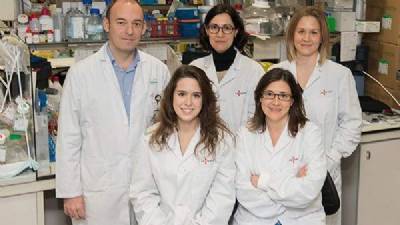
Photograph: The research team, featuring investigation leader Dr Núria de la Iglesias and PhD student and research author Marta Moreno (picture by IDIBAPS)
SPAIN'S National Research Council (CSIC) has announced a new book series seeking to debunk widely-held myths through scientific answers – including whether bread really makes you put on weight.
NEW legislation aiming to protect the public from telephone scams and cold-calling is under construction, and will attempt to attack it at source by tightening up on commercial use of customers' personal data.
OUTER space and the Bronze Age do not sit well in the same sentence – they may both have existed at the same time, but anyone based on Earth back then would not have known much, or anything, about what lies beyond.
A FIRM annual fixture for fans of the latest technology, the Barcelona-based Mobile World Congress (MWC) never fails to blow visitors' minds with creations they didn't know they needed. And these cutting-edge...