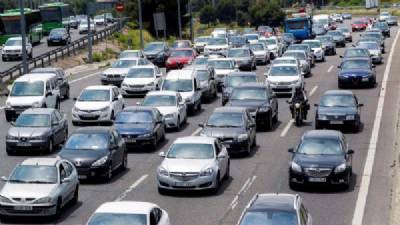
Summer traffic exodus starts with tailbacks on major motorways
Summer traffic exodus starts with tailbacks on major motorways
THIS weekend sees the start of the largest mass summer exodus by road in 13 years, with an estimated 89.3 million long-distance journeys expected over July and August – that's around two for every single inhabitant in Spain.
Bank holidays, school holidays and the first and last weekends of the two main summer months always see huge numbers of cars on main trunk roads across the country, normally heading for coast and country from inland cities, but this weekend – from last night (Friday) through to tomorrow (Sunday) – is expected to bring the heaviest volume of traffic for the first non-working days of July since 2005, and around 2% more than last summer.
A total of 85.2 million long-distance car journeys were reported over July and August 2005, rising to 86 million in 2006 and 87.7 million in 2007, although numbers fell to 76 million between 2009 and 2013, the leanest years of the financial crisis.
It has been steadily climbing since, rising to 87.6 million last July.
This year, the main three exodus periods are from June 29 to July 1, then over July 31 and August 1 – since many firms, especially in big cities, shut for the whole of August – and from August 31 to September 2 inclusive.
Extra movement will be seen over August 14 and 15, since the latter is a national holiday and many towns and cities will be celebrating their summer patron saint festivals, and also over weekends in the next two months.
Additionally, heavy traffic is frequent between June 15 and September 15 in the direction of Spain's southernmost tip as the country's high population of Moroccan nationals head across the Strait of Gibraltar by ferry for home visits – around 700,000 journeys in either direction normally take place over this three-month period.
So far, various traffic jams – although nothing out of the ordinary for the time of year – have been reported on parts of the A-1 motorway between Madrid and Burgos, and slow-moving vehicles on the A-2 in Torrejón de Ardoz (Madrid), the A-3 in the Valencia direction in Rivas-Vaciamadrid, the A-4 heading south out of the capital in Pinto and Aranjuez (Ciudad Real province), the A-42 in Fuenlabrada and Torrejón de la Calzada and the A-6 in Majadahonda and Las Rozas, all in the Greater Madrid region.
The A-2 into Barcelona and the C-58, a minor road in the same province, at Sant Quirçe del Vallès, plus the coastal motorway heading south from Barcelona in Barberá del Vallès and the Barcelona-province metropolitan roads, the B-10 and B-20 have all experienced traffic delays.
Most of the slowdowns – which have not yet reached gridlock proportions – in the Valencia area are in the wider airport and Madrid motorway junction towns of Riba-roja del Túria and Xirivella, whilst the A-70 motorway in Alicante on either side of the airport has seen some queues.
In the province of Málaga, the A-7 motorway at San Pedro de Alcántara in both directions and in Arroyo de la Miel in the Cádiz direction have been the site of various traffic jams since last night, and in the province of Sevilla, long queues have been reported on the A-4 in Bellavista in the Málaga direction and on the SE-30 both ways.
At the time of publication, no fatalities had been reported as yet.
The most tragic summer on Spain's roads in the last 48 years was in 1989, with 1,378 drivers and passengers killed, and the fewest deaths so far were in summer 2014, where 220 lost their lives after seven consecutive years of declining numbers of fatalities, gradually dropping from 447 in 2008, which was the first year since 1978 that fewer than 500 people had been killed on Spain's roads in summer.
Traffic police will, as is always the case during holiday periods, be out in force with extra officers and resources employed to keep drivers safe, be on hand in case of accidents and issue warnings of queues, lane-blocks, crashes and adverse conditions up ahead.
This year's 'Operation Exit', as the first weekend's exodus is known, will be accompanied by the highest fuel prices in four years.
Diesel is currently, on average, €1.223 per litre, with petrol at €1.319 per litre.
Although prices have not yet come near the historic highs of 2012, when petrol was over €1.50 a litre for the first time in history, they have gone up considerably since last summer – by 12.6% in the case of petrol and 17.4% for diesel.