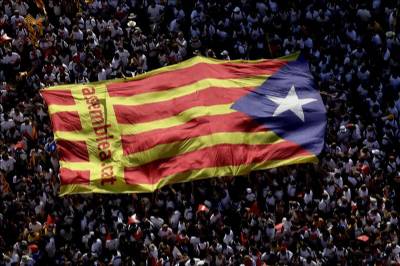
SPANISH president Pedro Sánchez's attempt to play devil's advocate over Catalunya has resulted in a proposal that both sides of the independence debate consider unworkable: a referendum on self-governing.
Given that the Spanish Constitution in its current form – unchanged since its signing in December 1978 – does not allow any action that could 'threaten the unity' of the country but does enshrine the 17 autonomous governments in law, the present interpretation is that any referendum on Catalunya's independence would be illegal, even if non-binding.
In a bid to bridge the ideological gap, Sánchez has offered Catalunya the chance to vote on whether or not they should be self-governing, but the Catalunya Left Republicans (ERC) have urged him to 'be brave' and go for a full-on self-determination poll.
Meanwhile, Pablo Casado, leader of the right-wing PP – ousted from national leadership by Sánchez's socialist party in early June after six-and-a-half years – says there is little point in a 'self-governing' vote.
It would be 'difficult to increase' the region's powers for self-rule, Casado argues, since 'there is nothing else that can be decentralised'.
Catalunya has its own police force, the Mossos d'Esquadra, even though the National Police and Guardia Civil still operate there to a certain degree, as well as its own traffic laws and a regional language which is the vehicle for teaching in all State schools there – a similar situation to that of the Basque Country, whose long-running campaign for independence was the main fuel behind the now-defunct terrorist organisation ETA.
Casado accuses Sánchez of sneakily sealing under-the-table deals with Catalunya's pro-independence lobby to ensure their continued support of his minority government, since it was their vote which allowed the no-confidence motion against the PP to go through and put the socialists in power.
But this would seem unlikely, since otherwise the pro-independence parties would be in favour of Sánchez's proposal of a referendum on self-governing and on amending the regional Statute – and they are not, as ERC spokeswoman Marta Vilalta reveals.
“[Sánchez] needs to be brave and have enough courage to approach this situation in the manner that the majority of the nation [meaning Catalunya] is asking for,” Sra Vilalta says.
“Our situation needs to be handled through dialogue and negotiation which then culminates in a vote on self-determination – we haven't been campaigning for more self-governing powers or a new Statute for the last decade; we've been campaigning for our right to decide our future.”
Left-wing Podemos is against Catalunya's independence but in favour of a referendum, believing that if the situation had been handled properly from the beginning with open dialogue and negotiation rather than simply prohibition and threats of court action, a people's vote would have probably resulted in a majority desire to remain part of Spain.
Deputy spokeswoman Noelia Vera says the solution remains that of offering a referendum on independence, but including a third option asking if voters want more self-governing powers instead.
Podemos' long-proposed solution is to open channels for frank discussion and then offer a non-binding referendum to 'sound out' the general public opinion, and work from the results of this.