
KING Felipe VI's annual Christmas Eve speech once again included a covert appeal to secessionist politicians, as well as raising concerns about young adults' struggle to afford housing and violence against women.
Sign in/Register
Looking for the Professionals/Advertiser Login?
By Signing up you are agreeing with our Terms and Privacy Policy.Forgot your password?
Feedback is welcome

In two days' time, the north-eastern territory will celebrate its regional holiday, known as the Diada de Catalunya which, in the past few years, has seen a growing pro-secession flavour to it and it is expected the 2018 edition will be the most nationalist yet.
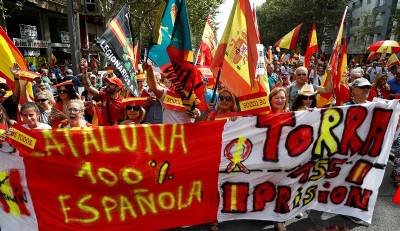
But around 65 associations, numbering half a million people – although the metropolitan police, or Guardia Urbana, said it was nearer 2,000 – took to the streets today to show that the separatist movement is not representative of everybody.
Moments of tension arose in places, especially where some 200 members of anti-fascist associations were holding a parallel demonstration, particularly given the presence of far-right independent political party VOX.
The anti-fascists called the anti-independence marchers 'fascists', whilst the anti-independence marchers called the anti-fascists 'Nazis'.
But a police blockade prevented the two groups from approaching each other.
The anti-independence protesters called for 'dignity' and 'unity' and declared 'Catalunya is 100% Spanish', but many also carried inflammatory placards reading, 'we don't want people like this in Spain', 'Torra prison' and 'Puigdemont prison' – referring to the current and former regional presidents respectively, who are strongly in favour of secession – and 'Article 155 now', in allusion to said clause in the Spanish Constitution which was invoked in October temporarily, stripping Catalunya of its self-governing powers in response to the disputed independence referendum.
Some declared, 'Long live the National Police and the Guardia Civil' and 'Kick the Mossos out', in reference to Catalunya's regional police force whose powers were forcibly undermined during the referendum in case they supported the vote.
The huge demonstration was organised by Basque businessman José Manuel Opazo, who is living in Switzerland, meaning opponents of his cause question whether he had a right to try to influence the public in this way – although he reveals he owns a company in Catalunya and was a Guardia Civil for seven years.
Opazo said the aim was to 'halt the drifting path' of a national government which had 'crossed red lines' and said it was 'not fair to form pacts with people who want to destroy a nation or harm people'.
By this, he meant the current socialist government, which came into power on June 2 after a no-confidence vote ousted the reigning right-wing PP, for which the new president, Pedro Sánchez, needed the backing of some of the Catalunya regional parties as he only holds 84 seats in Parliament out of a total of 351.
Unlike the PP, which refused to even discuss the growing independence sentiment and simply threatened any politicians who attempted to hold a vote, non-binding or otherwise, with prison and court action, Sánchez's policy is to open dialogue and try to reach compromises.
Right-wing opposition members claim he is kow-towing to the separatists because he needs them to stay in government, but there has been no sign as yet of Sánchez's giving way and agreeing to a legal referendum.
Further still to the left, Podemos wants Sánchez to allow a referendum, even a non-binding one, believing that if the situation had been handled with constructive discussion instead of threats and the people given a chance to have their say, the majority would have voted to remain as part of Spain.
Many left-leaning politicians have compared the situation to Scotland, where the region was allowed to have a proper, legal referendum, and in the end voted to remain within the UK.
But in Catalunya's case, those who were against the whole secession issue refused to vote as they considered the polling illegal, meaning of those who did – approximately 42% of those eligible – over 90% opted for independence.
KING Felipe VI's annual Christmas Eve speech once again included a covert appeal to secessionist politicians, as well as raising concerns about young adults' struggle to afford housing and violence against women.
'BRAVE' servicemen and women who will spend Christmas overseas are 'making Spain proud', president Pedro Sánchez assured them during his annual festive message via video-call.
NEWLY sworn-in national president Pedro Sánchez is now starting the challenging task of building his cabinet among a very divided coalition, although several names from his previous tenure are tipped to be returning to...
A NEW and limited-edition €2 coin will be in circulation in Spain until the end of this year to mark the country's Council of Europe presidency 'shift', the Royal mint has revealed.