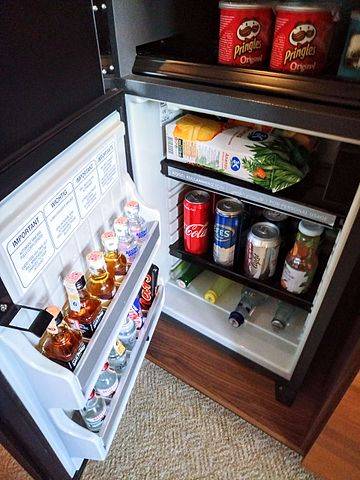
NINE in 10 hotels on the Costa Blanca plan to scrap mini-bars in rooms, partly because of cheeky tourists refilling bottles to avoid paying.
Their decision has also been triggered by lack of use: few guests want to pay the excessive prices of up to €6 for a can of Coca-Cola, €7 for a small bottle of tonic water or €8 for a Red Bull or similar. Yet mini-bars are actually loss-making, according to Costa Blanca hoteliers' association HOSBEC: the man-hours spent maintaining and checking the fridge contents are not covered by the amount spent by guests on their consumption.
And, of course, costs inflate still further when guests refill gin and vodka bottles with water or dark rum, whisky and brandy bottles with apple juice or black tea.
Most hotels which have scrapped the mini-bar still keep the fridges, though, so guests can use them for their own water bottles and other perishables.
Are Spaniards Europe's naughtiest tourists...or just the most honest?
Refilling mini-bar bottles is something 35% of Spanish tourists admit to having done at least once, according to a survey by Hotelscan.com.
The questionnaire, seeking to find the cheekiest nationality of holidaymakers in Europe, asked respondents to own up (anonymously, of course) to having broken the rules, giving a list of the most common 'hotel cheats' and unethical holiday hacks. According to the survey, Spaniards are by far the worst type of tourists, with 90% having 'fessed up to these stunts, followed by the Italians (87%), Portuguese (82%), Brits (78%), and French (67%).
At least, Spaniards are the most honest; it is equally possible that other nationalities are far worse, but opted not to own up to their bad behaviour abroad.
Pinching towels, letting friends in for breakfast, smoking out of windows...
If you're one of the 78% of Brits or 90% of Spaniards who flout the rules, there's a good chance you'll be wincing with recognition as you read this; you may have even thought you invented these 'trade secrets' and patted yourself on the back for being so clever.
The most-committed offence admitted to was among guests on bed-and-breakfast only who, to save the cost of lunch, made themselves a sneaky sandwich during the morning buffet and slipped it into their bags, sometimes along with a yoghurt, piece of fruit or cake to give themselves a free picnic. Seven in 10 Spanish holidaymakers said they had done this at least once.
Spanish hotels are still permitted to offer smoking rooms if they have them, but where they do not – or in other countries where smoking is not allowed inside any hotel – the majority of guests from Spain still manage to avoid going out in the cold for a fag. Of the total number of Spanish respondents, 53% (note: not 53% of smokers, but 53% of all guests) owned up to having leant out of the window for a cigarette in a non-smoking room, or smoked in the bathroom and then run the shower on hot so the steam flushed out the smell.
This could cost them more than the holiday in some parts of the world: in four- and five-star hotels in some Australian cities, such as Sydney, guests are often required to sign a contract upon check-in to confirm that if they break the rules and smoke in their rooms, they agree to pay a supplement of AU$500 (currently around €400) for cleaning upon leaving.
Honeymooners and those holidaying to celebrate a milestone, such as a 'big' birthday or anniversary, are normally the biggest offenders, but not exclusively: 42% of Spaniards admitted to stealing hotel towels or complementary dressing gowns or slippers as a 'souvenir'.
Many more stock up on the miniature bottles of shampoo and shower gel and take them all home unused, but surprisingly, a few smaller hoteliers say they do not really mind: these inexpensive items bear the premises' name and, as other people will see them in the guests' bathrooms at home, it helps advertise the resort.
Other scams, typically in smaller hotels where room numbers are not checked upon entering the breakfast hall, include inviting friends in who go upstairs, take the lift down again so they appear to be legitimate guests, and walk into the buffet room to pig out for free. And 10% of Spaniards confessed to having sneaked another person into their rooms so they could stay there without paying.
'Sunbed blocking' is an annoying practice nearly one in three (28%) have been guilty of: spreading out towels on loungers by the pool and leaving them there all day, or even 'reserving' sunbeds the night before.
This is the sister offence of 'beach blocking', or pitching parasols and towels in prime positions nearest the sea from the early hours so as not to have to fight for space later in the day – but many town halls are getting wise to this and issuing fines. And in Gandia (Valencia province), Local Police will collect up your abandoned gear and lock them away until you reclaim them.
Taking a dip in the swimming pool when it is closed is, perhaps surprisingly, something only 8% of Spaniards admit to having done; and, in practice, is probably one of the lesser offences, except that as lifeguards will not be on duty, the bather runs a greater risk.
Generally, hotel staff know what you're up to, however. These little scams are so common that they're on the look-out for them all the time, and some are bringing in new measures to ensure they're a step ahead of their brazen guests.
Textile firm Resuinsa 4.0 has created ranges of 'smart towels' which carry chips, so hotels can locate them and even tell whether they have been washed. Be warned: those honeymoon souvenirs may come back to bite you!