Altamira, Cantabria: 150 years since world's first cave art discovery
Altamira, Cantabria: 150 years since world's first cave art discovery
A DOG, a weaver, an eight-year-old girl and a landowner with a spade formed the cast.
The opening line was: “Look, daddy! Oxen!”
And the setting: a communal home, uninhabited and forgotten for over 13,000 years.
Cantabria, on Spain's blustery northern coast, was sitting on a future UNESCO heritage site that, half a century on, would start to accumulate queues of camera-clicking tourists from every continent.
If María Sanz de Sautuola y Escalante could have lived to the age of 148, she would have seen her oxen (which was actually a bison) in motion for the first time a week ago on Tuesday, galloping across the Google 'doodle of the day', to mark the anniversary of the discovery of the Altamira Caves, on September 25, 1868 – although, in practice, it is she who should take the credit for being the first person in the world to see the first prehistoric cave paintings on earth ever uncovered in the Anno Domini era.
Because when Modesto Cubillas, a weaver from Cantabria's western neighbour, Asturias, first clambered into an unremarkable hole in the ground to free his trapped dog, he just assumed it was yet another grotto in the hillside, of which there were hundreds near the coastal town of Santillana del Mar.
He only thought to mention it in passing to his wealthy property tycoon mate Marcelino Sanz de Sautuola, and only then because this friend of his was a bit of a fan of Palaeontology.
(And – because we know you're worried – the dog was perfectly fine and none the worse for his little escapade into Spain's 35,000-year-old underground).
Marcelino was so underwhelmed at the news that it would take him another seven years to go for a poke around the area, and he found nothing to get excited about.
But four years on, in 1879, his curiosity was pricking him a bit, so he went back there with his daughter María, eight, and sent her down the hole as it was too small for a grown-up to squeeze through.
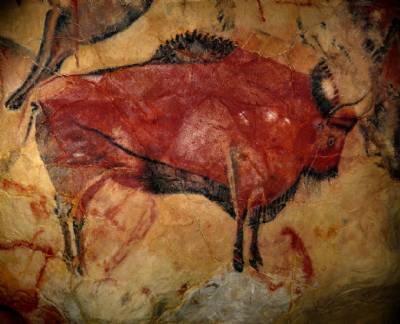
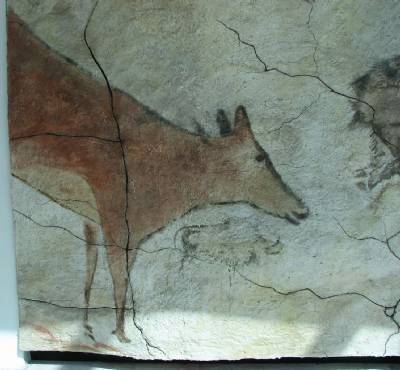
What she found down the long, narrow gallery would, by the mid-1980s, become known as the 'Sistine Chapel of Palaeolythic art': over 260 paintings and carvings, and an 18-metre-high vault with over 30 images of animals including bison, horses, wild boar and deer – of which the most famous today, arguably the most expressive and certainly the most admired, is the so-called Bisonte Encogido, or 'crouching bison', a female with her legs folded beneath her and her head tucked in – many of which were up to two metres in height.
“It wasn't me, it was the cavemen”
It would not be until long after Marcelino's death that the cave and its colourful contents would be recognised as the ground-breaking discovery we now know them to be; prehistoric cave art had never been seen in living history, and Marcelino was widely accused of having painted them himself in an attempt to become famous and even richer. At least until the end of the Environment of Evolutionary Adaptiveness (EEA) in the late Pleistocene era around 10,000 years ago – the beginning of modern-day human culture and civilisation – artistic techniques were not thought to have existed; historians found it hard to believe that the savage stone-age tribes of early man could have possessed such intricate forms of graphic expression.
Not until the 1890s and early 1900s, when similar caricatures were discovered in the caves of La Mouthe, Combarelles and Font-de-Gaume in France, did anyone believe the animal pictures in the Altamira grotto were anything other than contemporary art.
Numerous excavations and studies followed over the next few decades, and although the Altamira caves opened to the public 101 years ago, they were shut again 60 years later as mass tourism was actually altering the micro-climate inside and jeopardising the paintings' conservation: in 1973 alone, 174,000 people traipsed in and out, forcing a Parliamentary debate on its future as a visitor attraction. The caves have been opened and shut again several times in 41 years, and currently only five people are allowed in at a time for exactly 37 minutes.
Salmon and Scottish weather
Thought to have been inhabited for the first time 35,600 years ago, various tribes moved in and out, occupying the Altamira caves almost continuously for some 22,000 years, eventually being abandoned altogether about 13,000 years back.
The very last dwellers were the earliest Homo Sapiens, or modern man, although some debate still exists as to whether pre-evolution humans and the earlier Neanderthals, who would have been among the first settlers in the Altamira caves, actually lived alongside each other.
No clear answer has been found as yet; other theories claim that Neanderthals did not become extinct, but instead evolved into Homo Sapiens, a hypothesis cited in recent years during cave excavations in Pedreguer (Alicante province) and Oliva (Valencia province).
But experts are fairly certain the animal paintings in the Altamira came along several millennia after the Neanderthals had either morphed into Homo Sapiens or died out.
What is fairly certain, however, is that during the 22,000 years of the Altamira's occupation and until shortly before the EEA, the climate was very different: until the 'global warming' of 12,000 years ago, weather in Cantabria would have been similar to that in the far north of Scotland today, with exceptionally cold winters and brief, cool summers.
In fact, it was so cold that reindeer are believed to have roamed wild there.
And 'Altamira man' would have been as fond of seafood and fish as modern-day Cantabrians: shells and bones found in the caves show its occupants lived not only on game, but on whelks, scallops, trout and salmon, due to the proximity of the sea and the presence of rivers.
This treasure trove of early hominid history became a UNESCO heritage site in 1985, one of 40 in Spain, a country with the second-highest number of these in Europe after Italy and the third-highest in the world, after Italy and China.