Why is everyone taking their pets to church? A 105-year-old Egyptian has the answer...
Why is everyone taking their pets to church? A 105-year-old Egyptian has the answer...
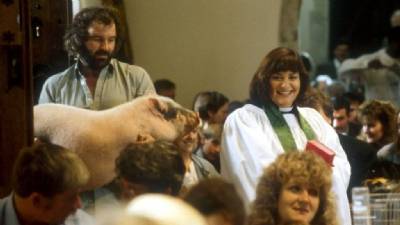
ANYONE who's followed UK TV comedy in the last 25-odd years may remember that scene from The Vicar of Dibley where the Revd Geraldine Granger (aka Dawn French) fills her local church with cats and dogs. Quite amusing, wasn't it?
Well, if you've lived in Spain for more than a year, chances are you've actually seen it in the flesh.
If you haven't, you may get the opportunity to witness it tomorrow (Sunday).
One might argue that there's no creature on earth more blessed than a domestic cat or dog. Who wouldn't want to come back as either? No bills to pay, no work to go to, parents to clean up after you (including when you go to the loo) and feed you and hug you on demand. Okay, dogs have to ask permission to go outside for a number one or two, cats have to bath themselves with their tongues (why doesn't it give them jaw-ache?) but they both get to spend all day sleeping if they feel like it, everyone loves them and thinks they're gorgeous just because they exist. And even if they ate too much at Christmas and piled on weight, they still look gorgeous. Without makeup.
One might also argue it's cat- and dog-owners themselves who are blessed. They think we're gorgeous, even without makeup and if we've piled on weight over Christmas; they're excited to see us when we come home, just because it's us; they treble up as hot-water bottles, cushions and counsellors, and they'll never, ever mention Brexit in your presence and spoil your day.
But perhaps a bit of additional blessing wouldn't go amiss, just to bring some extra luck for your fluffy friends; and seeing a priest might grip their conscience over that time they shredded an entire family pack of toilet roll and spread it on the floor, chucked your mobile phone in your cup of tea, peed in your plant pots, or ate your Mercadona bag stash and puked it up all over your best rug.
Maybe they'll miaow a few Hail Marys or bark the Lord's Prayer in penitence; or maybe they'll just think they're going to the vet's as soon as you put them on a lead or in a basket and will plot a similar house-wrecking revenge for their return.
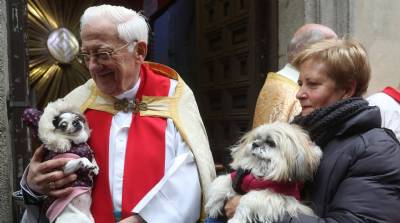
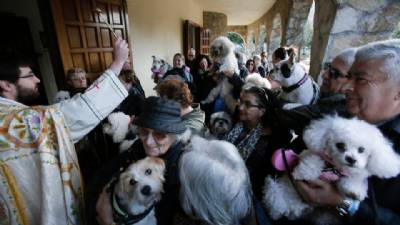
If you're brave enough, you might decide to take your pets with you this Sunday for the annual animal blessing in honour of San Antón, or Saint Anthony; if, like most of us, you're not, then the ceremony is definitely worth the detour for the cuteness of it (bring earplugs and watch out for cow-pats).
Pets of every variety are likely to be in the queue for the priest to give them their Holy pat on the head – and farm animals, too; both the working variety and ones kept as family friends, like horses or, increasingly more often, pigs (the Vietnamese version can be trained to walk on leads).
Until a few decades ago, the furry and feathery San Antón congregation was nearly always made up of livestock – working horses and donkeys, cows, pigs, sheep, even hens – as farmers hoped by getting their animals blessed, they would enjoy good health and yield more in the year to come.
Then, as now, the animal blessing is held outside, typically in a public plaza, church square or at the end of a pilgrimage to a hilltop hermitage, rather than squashed between pews – and thank goodness, for the priest's sake, and for the caretakers, since it would take years to get the stench of cat-wee out of the kneeling pads during the post-service clean-up.
It's noisy, silly and heart-melting for animal-loving spectators, and is one of the most unique and visual of Spain's saintly traditions; but it does beg the question: how did the events in the life of Saint Anthony lead to this hilarious cute-fest exactly 1,663 years after his death?
'Guardian wild boar' and lion grave-diggers? A day in the life of a desert hermit
Pet-ownership is probably one of the secrets to a long life, if San Antón's story is typical: rare for that time in history, the Egyptian-born Christian monk is said to have lived to 105 years old, from January 12, 251 AD to January 17, 356 AD. According to legend, he was approached by a wild boar in the desert, begging him to help her cubs, who had all been born blind – and, after he succeeded in restoring their sight, the mother boar was so grateful that she remained by Anthony's side for the rest of his days, guarding him against danger and evil spirits.
Another explanation for why San Antón became the patron of animals was that, after years of feeding bread every day to Paul the Hermit to keep him from starvation, when the latter eventually died, San Antón buried him with the help of two lions and various other wild creatures.
This version may be the reason why the animal blessing every January includes slices of 'holy bread' being handed out to the human members of the congregation, and is likely to be why he is also the patron of grave-diggers.
Perhaps another secret to long life is giving away all one's possessions to the poor and living in a cave as a hermit, as San Antón did from the age of around 20 – but most of us would probably prefer to get a cat instead and remain in the warm. Plus, there's plenty more we can do for the poor, such as charity fundraisers or online collections, and taking groceries and other essentials round to local food banks – check with them before you hit the supermarket, though, as most organisations like the Red Cross and Cáritas have set lists of what they most need for their charges.
This does explain, however, why San Antón is also the patron of hermits, although it is not clear why, in addition, he is the patron of amputees, basket-weavers, broom-makers and people with skin disorders. Anyone who falls into any of these categories is often known to head to the animal blessing to get some well wishes themselves – in fact, for decades, if not centuries, ezcema-sufferers have been turning their prayers to San Antón for some relief from their itching and discomfort.
San Antón Day is celebrated in Catholic and Lutherist communities as the date of his death, January 17, although the Orthodox Church marks it on January 30 – but the animal blessing ceremony is nearly always on the nearest Sunday. A handful of towns and villages may have held theirs last week, on January 13, or on actual San Antón's Day, but the majority will fill their plazas with pets tomorrow, January 20.
Fayres and craft markets
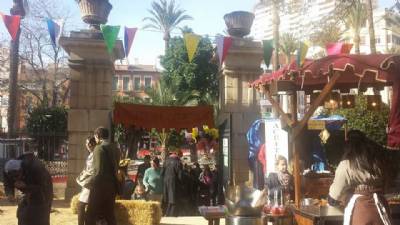
Most towns that organise a mass pet-blessing also hold a traditional outdoor fayre – in Catalunya and the Valencia region, this will be in the form of a porrat, originally a market selling dried fruit and confectionery, and now more likely to be a Mediaeval market with a few stalls stacked with the latter goodies, as shown in the fourth picture by Alicante tourist board.
Mediaeval markets are more common in eastern Spain than anywhere else in the country, but may come under different guises across regions – typically, they include handicrafts and hand-made organic foodstuffs such as cheese and sausages, with plenty of jewellery, accessories and household decorative items on sale, along with peripheral activities that may involve live music, jousting, juggling, theatrics, puppet shows, birds of prey demonstrations, and pottery, leatherwork or carpentry workshops. Stallholders tend to be in Mediaeval costume and, as the Middle Ages was when Spain's population was predominantly Arab following the Moorish landings, expect to find Moroccan and Algerian tea tents and a general North African theme running through the day.
Keep the home fires burning
In some parts of the country, particularly in the land-locked eastern region of Aragón, residents and visitors have a flaming good time at the San Antón festivals. Huge camp-fires are built up, food is roasted on them, locals dance around them (alcohol helps, and as we know, is a staple ingredient of any Spanish fiesta), and feuds across the garden fence are condemned to ashes – since, although the San Antón bonfires tend to be shared between friends and family, some smaller villages have a tradition of next-door neighbours lighting joint ones and spending the evening together; a partnership deemed compulsory for one night only, even if they never speak to each other again for the rest of the year.
The bonfire custom does not seem to be directly linked to Saint Anthony: aside from the fact that it gets incredibly cold in Aragón in January (which also means snow; ergo, brilliant ski resorts) the whole idea seems to be about 'cleansing' by setting fire to the winter or to the old year to make way for the spring or the new year – an earlier version of Valencia's famous Fallas festival in March.
Bonfires and Mediaeval markets are great fun, but you'll find plenty of these at other fiestas in Spain – pets in church, however, isn't something you catch sight of every day, or even at every festival. So, if you're seeking a true anecdote-generating experience, follow the woofs, neighs, miaows, baas, oinks, ee-yores, moos, squeaks and whatever noises rabbits, ferrets and iguanas make to find out where the San Antón blessing is happening near you. Remember to pack your camera, too, because we can promise your Facebook footage of the ceremony will get more 'likes' than Justin Bieber and all the Kardashians put together.
Photographs 1 and 3: Uly Martín
Photograph 2: Screen shot from The Vicar of Dibley Series 1, Episode 6 (1994)