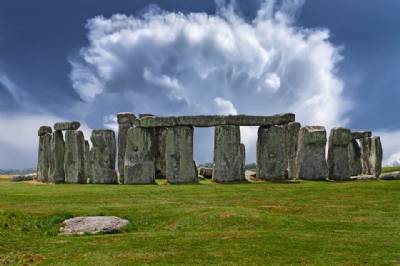
A CANDIDATE in the 21-strong shortlist for the New Seven Wonders of the World in 2007, Stonehenge represents one of the UK's greatest mysteries.
Like the only surviving member of the original seven wonders - the Pyramids of Giza in Cairo, Egypt - how this huge circle of standing stones was built has always been part of the great unknown of Europe's most ancient history.
But we do know a little about the actual builders: London's Natural History Museum has revealed that they could well have been Spanish or Portuguese.
Experts in prehistoric genetics compared DNA from the remains of late Neolithic and early Bronze Age humans from what is now known as Europe, and found that that of the vast majority of those living in the modern-day UK were almost identical to that of humans living on the Iberian Peninsula.
Stonehenge is believed to have been built in what is now the county of Wiltshire back then, and humans from the Iberian Peninsula are thought to have been responsible for introducing the tradition of constructing monuments with megaliths, or gigantic stones, into the north-western part of the continent.
In fact, the UK probably had more Spanish and Portuguese expats 5,018 years ago than it does today: Tom Booth, co-author of the research, says no 'detectable evidence' of native British hunter-gatherers' DNA was found in the remains of Neolithic farmers after the arrival of the Iberians.
So, in effect, the Spanish and Portuguese migrants ended up replacing born-and-bred Brits.
Turkey, Iberia, France, Wales…
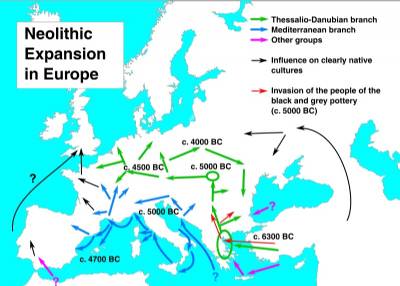
According to the research, the largest migratory movement across Europe was in around 6,000 BC - or three millennia before work started on Stonehenge.
Farming communities set off en masse from Anatolia, now Turkey, and split into two branches: one group followed the river Danube and ended up in central Europe, whilst a second diaspora crossed the Mediterranean in 4,000 BC to Iberia.
These nomads, generations later, began to spread out through France and then Wales, their point of entry into the UK, and dispersed across the south-west of England.
Thousands of years of migration led to Iberians, distantly descended from the Anatolians, becoming the dominant population in Britain, at least in the southern and western areas.
Although the climate and conditions for farming would have been very different in England and Wales to in Spain and Portugal, the long journey north and west across Europe would have given them plenty of time to adapt their practices to enable them to survive by the time they reached Britain, according to another co-author of the research, Mark Thomas, of University College London.
The small groups of native British hunter-gatherers, who would have lived largely on plants and molluscs, were replaced over time by Neolithic migrants, most of whom were farmers - not because the two groups never mixed, says Tom Booth, but because it was likely that the British population was too small to have left any real genetic legacy, and perhaps the vast majority of the ethnicity had fizzled out long before the Stonehenge workers were born.
Early native Brits were black and Mediterraneans were pale, says study
Research has already shown the physical differences in typical Turkish-Iberian migrants and native British hunter-gatherers: last year, in February, Tom Booth's team at the Natural History Museum stunned the world by revealing that the earliest Brits were very dark-skinned with black, curly hair and blue eyes.
This was discovered after examining the fossilised skull of whom the team dubbed The Cheddar Man - because his remains were found 100 years earlier in Cheddar Gorge, Somerset - and extracting a few milligrams of bone powder, which enabled them to build up an entire genome profile which made it possible to create an accurate reconstruction of the head (shown in the third picture).
Thought to have been living in Britain between 10,000 and 11,700 years ago - before which the UK populations were periodically wiped out in their entirety during different ice ages, meaning they left no DNA in the pool - The Cheddar Man's DNA is shared with at least one in 10 members of the country's population with white British ancestry alive today.
The Natural History Museum team believes white skin came along later in Europe - an evolutionary adaptation created by the emergence and diffusion of farming practices which would have changed humans' diets, providing them with less vitamin D. Earlier diets would have included molluscs and oily fish, sources of vitamin D, which is necessary for calcium absorption and healthy bones. Without dietary vitamin D, humans' only source would have been sunlight, and paler skin absorbs more of this than darker skin.
But the black-skinned British natives were still around, in very reduced numbers, by the time the Turkish-Iberians arrived - even though, by then, these Mediterranean tribes were pale-skinned with light-coloured hair and brown eyes.
When Spanish people were blue-eyed blondes
Spaniards were, in fact, mostly blonde with blue eyes and very pale skin until about 1,200 years ago, tending to resemble present-day Europeans of Scandinavian and Germanic descent, meaning their current tendency towards dark hair and eyes is very modern, in evolutionary terms. Whilst it is difficult to define the appearance of a 'typical' native Spaniard, they are, on average, darker in hair and eye colour than today's humans of northern European descent and, although white-skinned, are marginally less pale and tend to tan very quickly and be less prone to sunburn.
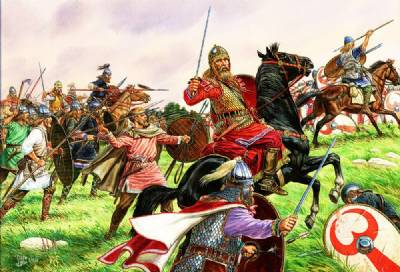
This change from a Nordic profile, as depicted in the fourth picture of Spanish Visigoths, to what is now looked upon as a Mediterranean typology began to appear with the migration and settlement of the Moors from north Africa in the eighth century: rather than colonising the peninsula, they moved in and expanded, mixed marriages and mixed-race children were common, eventually giving Mediaeval Spaniards an appearance closer to that of the Arab community they lived with. Also, a mix of early gypsy origin is present in some modern-day Spaniards: this ethnic, known in Spain as gitanos, are thought to have made their way from the Punjab region of India across eastern Europe centuries ago, and their communities, also, mixed with born-and-bred Spaniards.
From as early as the year 7,100 BC, when the bulk of human evolution is believed to have been completed and 'modern man' first established, up to the beginning of the Mediaeval era, skin colour had less to do with geographical origin than it does today, Tom Booth said a year ago when unveiling the mock-up of The Cheddar Man.
Although now, with migration able to happen faster than ever before - travel does not need to be on foot in tribes and continents can be crossed by air in hours - it is likely that a reversion will happen and the DNA mix in natives of many of the world’s wealthiest countries will become more and more eclectic.