
Foreign incomers push population above 48 million for first time ever
SPAIN'S headcount has risen to its highest figure in history – for the first time ever, the population has broken the 48 million barrier.
Sign in/Register
Looking for the Professionals/Advertiser Login?
By Signing up you are agreeing with our Terms and Privacy Policy.Forgot your password?
Feedback is welcome


Already, the party led by hitherto president Pedro Sánchez has begun discussing and agreeing tax hikes for those on six-figure salaries in order to claw back extra funding for the public pot without increasing financial pressure on the average worker and small business owner – but as Sánchez will be governing in a minority, it is likely his left-wing allies on other parties will want to include their own input as a condition of supporting his presidential bid in the in-house voting round, and which will probably include reduced taxes and improved conditions for pensioners, families and the workforce.
This could lead to some light relief for the middle and working classes, who are not yet out of the woods after feeling the pinch from austerity measures introduced back in 2012 when the previous right-wing PP government was in power – measures that were partly dictated by the financial crisis and Spain's national debt, and partly as a result of the bail-out funds sought from the European Union to save collapsing high-street banks.
'Ground-breaking' government policies
Unai Sordo, head of the Labourers' Commissions (Comisiones Obreras, or CCOO) said it was clear from the annual May Day demonstration, just three days after the elections, what workers wanted from their new left-wing government bloc: “The election results need to come with a major commitment to the social agenda and for the fight against inequality and job insecurity to become the main priority of the new government,” Sordo (second picture) says.
“When this happens, it will be a ground-breaking day for building a new social contract for Spain.
“We in the unions presented a catalogue of needs to the different parties ahead of the elections, and its content was what the May Day demonstrations focused on.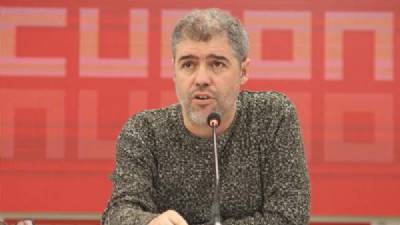
“The new government's main challenge will be ending the culture of lack of job security and temporary jobs – this precarious labour situation is hardest on young adults and on women. It's a situation that has become chronic in our country, and is closely linked to low wages and a high percentage of jobs in the market being part-time and temporary; all this is closely linked to recent labour reforms.”
Ending – or redrafting – the 2012 labour reform
The PP's 2012 labour reform aimed to make it easier and cheaper for companies to fire workers or make them redundant, believing that the high cost of severance pay and the limited legal reasons for letting staff go were the main causes of firms being reluctant to take on new staff, rather than, as is more commonly the case, the high labour costs employers face, which also serve to drive down wages.
These moves turned out to be beneficial for smaller companies who needed to shed jobs in order to stay afloat and who would otherwise have to shut down altogether, making even more people redundant, but also meant less-scrupulous employers had few barriers to hiring and firing and squeezing more work out of those remaining, and meant employees could never plan their lives more than a few weeks ahead in case they were next on the hit list – a factor which also affected the housing market as these conditions were not conducive to committing themselves to a mortgage.
Various experts consulted over the years since 2012 upheld the view that the PP's labour reform was more harmful than beneficial on the whole, and both the European Union and the International Monetary Fund (FMI) have been strongly advising Spain to tackle its problem of lack of long-term job security.

When Pedro Sánchez took power via a no-confidence vote against the PP last June, he vowed to scrap the 2012 labour reform, or at least amend it beyond recognition, and his pledge was wholly backed by Spain's fourth-largest political force, the left-wing Podemos, as well as several left-leaning regional parties such as Compromís (Valencia) and En Marea (Galicia).
“Millions of Spaniards are hoping for a more just and fair country and a better future,” Unai Sordo explains.
“As for the timeframe the government should set itself to do this – as far as we're concerned, the deadline has long passed, although logically, institutional and political time periods have to be taken into consideration. Basically, though, as soon as Parliament reopens for business, it needs to hit he ground running as productively as possible.
“We at the CCOO are not going to give up: we have always said that whatever shape of government emerged victorious from the ballots on April 28 had a big task in its in-tray which was urgent to tackle from day one, with no excuses.”
Left-leaning coalition 'inevitable and advisable'
The PSOE (socialists) earned 123 seats out of 351, leaving it 53 seats short of an outright majority, but major party figureheads agreed that this majority would from now on always be a chimaera and that Spain's politicians would have to accept the inevitability of governing in coalition, or in a minority with support from other parties, from now on, given that elections are no longer a straight contest between the 'Big Two' – the PP and the PSOE – with other, newer, independent outfits having soared to the top.
Although Sánchez has said he would rather the PSOE governed alone in a minority with support from left-wing allies, so as not to be 'held hostage' to demands of other parties, it is likely he will have to consider a coalition – and the CCOO considers it 'logical' and 'necessary' that any coalition that heads up Parliament should be entirely left-wing.
Already, after Sánchez gained power in June with the support of Podemos and smaller, regional parties, 'social and labour policies changed direction' and, although with 'much room for improvement', they were 'focusing in the right direction', Sordo argues.
“But then, their materialisation was fraught with hurdles, both through the social conflict in Catalunya [Sánchez needed votes in favour from the pro-independence parties in the region to enable him to govern] and through the weakness of the government itself [with only 85 seats in Parliament out of 351], and other factors.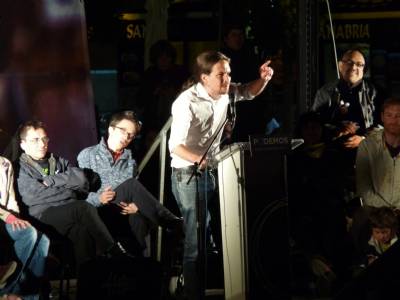
“The various parties who were working hard on these issues are urged to continue with this valuable work and ensure they take centre stage, somehow or another – and the CCOO will help them to ensure this happens in the most productive manner possible.”
These parties broadly included Podemos (fourth picture) and other regional outfits, and Podemos based its own campaign on measures that included a minimum wage and State pension of €1,000 to €1,200 a month and a guaranteed 'survival income' for jobseekers and those on sick or disabled pay of between €600 and €1,200 a month.
Podemos also wants to scrap temporary job contracts of less than a month, although it is likely some exceptions will have to apply: for example, a contract drawn up for a person working as an extra in a film or TV series is likely to have to be for a maximum of a day or two, by definition, and is normally something that can be undertaken by someone who is already working.
Sánchez's earlier attempts to become president, following the fragmented result of the November 2015 election and its repeat performance in summer 2016, were thwarted after Podemos took exception to the PSOE's bid to create a coalition with centre-right Ciudadanos, largely aimed at keeping the PP out of power.
In the run-up to the April 28 elections, however, Ciudadanos took on a much more right-leaning approach and was determined to form a coalition with the PP, which had swung even farther to the right, if the numbers added up.
Meanwhile, the PP was not averse to creating a coalition with the newer, far-right party Vox, which netted one in 10 of the votes and 24 seats in Parliament, even though Ciudadanos was less keen on becoming involved with them.
Ciudadanos and the PSOE have both said they have no intention of forming a coalition with each other, even though the very same leaders tried to do so in 2016, and Unai Sordo believes such a union would not work and should not even be contemplated.
“Right now, based on the views of both sides, a PSOE-Ciudadanos coalition looks like science fiction,” he quipped.
“But in any case, such a government would go against the sentiments expressed by voters last Sunday, who mainly cast their ballots in favour of the left.
“It would also go against the wishes of those who voted for Ciudadanos, who chose them on the basis of their right-leaning thinking.”
Tax hikes for the highest incomes to 'increase stability'
In the meantime, Sánchez's cabinet has sent Brussels a draft 2019-2022 Stability Plan since the elections, covering tax increases which would amass nearly €5.7 billion from next year onwards.
A minimum figure for Impuesto sobre Sociedades – 'company tax', charged on profits – of 15% for large corporations and up to 18% for banks and fossil-fuel firms, and the nominal figure of 25% on small and medium-sized businesses to drop to 23% has been proposed, but exact percentages have not been fixed.
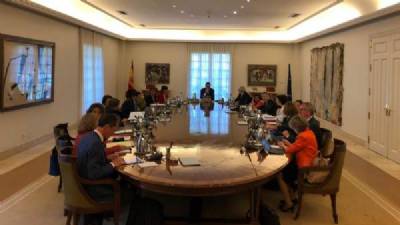
Income tax would be raised by two percentage points for salaries or other earnings of between €130,000 and €140,000 gross per annum, and four percentage points for those over €140,000, as part of a 'progressive rise in taxation on the highest earnings' and on savings above a 'certain threshold'.
This move would bring in €328 million in 2020 and €340m in 2021.
With the increase in percentage of taxes on ultra-high net-worth assets, the government expects to claw back €339m a year from next year, and a planned anti-tax fraud law targeting major corporations and top earners would bring in a further €828m a year.
Two new taxes will be created, both of which Podemos included in its electoral manifesto and which Sánchez's cabinet announced intentions of months ago, pending approval from the European Union.
One of these, known as the 'Tobin Tax', is applied to financial transactions and would amass €850m a year from next year, and the other applies to certain digital services and is commonly referred to as 'the Google tax', which would bring in €1.2bn a year from next year.
Tax on diesel, amounting to an annual €670m and referred to as a 'green tax' would apply to professional use of this type of fuel, meaning car-owners may be spared, and will not affect agricultural workers, nor transport workers, many of whom are self-employed and work with their own lorries.
An increase of 7.4% in tax on administrations for their bureaucracy or 'paper-trail', and the already-announced changes to lottery winnings tax would apply from this or next year.
From 2012, lottery winnings became taxable for the first time at 20%, but from this year, the first €20,000 are exempt and, from 2020, the first €40,000 are tax-free.
In terms of encouraging equality, the government will allow companies to offset the salaries of women on their boards of directors as 'expenses', as an incentive to increase female presence in the running of large corporations and help women to 'break the glass ceiling'.
SPAIN'S headcount has risen to its highest figure in history – for the first time ever, the population has broken the 48 million barrier.

BUDGET clothing store Primark has announced plans to open another branch in Madrid next month – the chain's 61st retail outlet in Spain.

JUST two weeks after socialist president Pedro Sánchez was sworn in for a fresh term, his deputy Yolanda Díaz has expressed a desire to increase the minimum wage in Spain.

PRIMARY care doctors have been given the option to claim 75% of their State pension along with 100% of their salary to continue working beyond retirement age in a bid to address the shortage in Spain's health...