
KING Felipe VI's annual Christmas Eve speech once again included a covert appeal to secessionist politicians, as well as raising concerns about young adults' struggle to afford housing and violence against women.
Sign in/Register
Looking for the Professionals/Advertiser Login?
By Signing up you are agreeing with our Terms and Privacy Policy.Forgot your password?
Feedback is welcome

The left-wing PSOE took over regional Parliaments in Murcia and La Rioja from its direct rival, the right-wing PP, and also now leads the regional governments of the Balearic Islands, the Canary Islands, Aragón, Madrid, Asturias, Extremadura, Castilla y León and Castilla-La Mancha.
It had already consolidated its mandate in the Comunidad Valenciana, which opted to bring its own regional elections forward to April 28 to coincide with the general election.
Navarra Suma (NA+), a coalition of the centre-right Ciudadanos, the right-wing PP and the Navarra People's Union (UPN) won in the northern region of which Pamplona is the capital, whilst the centre-left Cantabria Regionalist Party (PRC) won in the northern coastal territory.
Regions which were not due for election yesterday (Sunday) were Galicia, run by the PP and presided by Alberto Núñez Feijóo; Andalucía, where a PP-Ciudadanos snatched power from the PSOE on December 2; Catalunya, governed by Quim Torra in a coalition between PDdeCAT and the ERC (Catalunya Left Republicans); and the Basque Country, where Íñigo Urkullu of the Basque National Party (PNV) has been Lehendakari, or regional president since 2012.
Although the PSOE has held onto – and gained – large swathes of the country in the local council elections, the two left-wing mayoresses in Spain's largest two cities have now lost their reign.
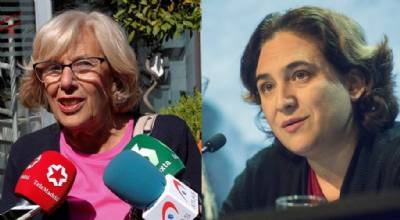
Ada Colau (pictured right) of the Podemos branch En Comú Podem has failed to hang onto the hotseat in Barcelona, where ERC's Ernest Maragall is set to become mayor, and ex-judge Manuela Carmena (pictured left)of the Podemos satellite party Ahora Madrid – running as part of the coalition Más Madrid ('More Madrid') has also lost her position.
The ERC coalition gained 10 seats, the same as Colau, but an ERC-socialist pact would give 18 seats, which looks to be the likely outcome and one which Colau has encouraged to ensure Barcelona remains under left-wing rule.
Carmena and Más Madrid won 19 seats in Spain's capital, but even in coalition with the PSOE's eight, she would not be able to govern.
The PP, led by José Luis Martínez-Almeida earned 15 seats – six fewer than in 2015 with Esperanza Aguirre at the helm – but with Ciudadanos' having gained 11, this would give Almeida 26 seats out of the required majority of 29.
It has not ruled out bringing far-right Vox on board, since its four seats would give a total of 30.
A pact between Manuela Carmena's party, the PSOE and Ciudadanos is considered very unlikely.
Six left-wing coalitions took over major cities in Spain following the May 2015 local elections, and called themselves 'governments of change' – but only two of these remain: Valencia, where leader of left-wing Compromís, Juan Ribó, has renewed his term of office, and in Cádiz, where José María González – known locally as 'Kichi' – leader of a Podemos-United Left coalition keeps his role.
Madrid and Barcelona were two of the four which will now face changes, along with Zaragoza (Aragón) where the Podemos coalition is likely to be replaced by a combination of the PP, Ciudadanos and Vox, and A Coruña (Galicia), where Podemos branch En Marea drops to six seats and either the PP or the PSOE, each with nine, will be able to govern depending upon the pacts they create with other parties.
Galicia national party BNG has obtained two seats and Ciudadanos one, and a majority of 14 is needed, meaning En Marea and the PSOE could join forces and retain left-wing rule in the city.
At local election level, the historic contest between the 'Big Two', the PP and PSOE, has long since been consigned to history – something which has only started to feature at national level in the last four years – since smaller, independent parties have often been on the scene and gunning for seats, frequently without identifying as either right- or left-leaning but basing their policies entirely on what they consider their town or city needs.
This means a high percentage of towns and cities in Spain are governed by coalitions.
KING Felipe VI's annual Christmas Eve speech once again included a covert appeal to secessionist politicians, as well as raising concerns about young adults' struggle to afford housing and violence against women.
'BRAVE' servicemen and women who will spend Christmas overseas are 'making Spain proud', president Pedro Sánchez assured them during his annual festive message via video-call.
NEWLY sworn-in national president Pedro Sánchez is now starting the challenging task of building his cabinet among a very divided coalition, although several names from his previous tenure are tipped to be returning to...
A NEW and limited-edition €2 coin will be in circulation in Spain until the end of this year to mark the country's Council of Europe presidency 'shift', the Royal mint has revealed.