FOUR seasons in one day – or at least in one week – are relatively common in May and the northern half of the country tends to be cooler than the south; but this weekend will bring a rare, extreme contrast, says the Met office.
Whilst residents in and visitors to Córdoba and Sevilla will be blessing the invention of air-conditioning, those in the Basque Country and Cantabria will be digging out their coats.
According to the State meteorological agency, AEMET, temperatures at either end of the mainland between Thursday and Sunday will be polar opposites – in a manner of speaking – reaching up to 37ºC in the south and barely reaching 14ºC in the north.
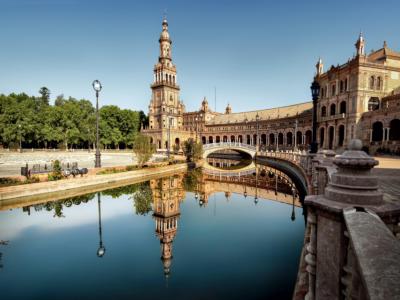
The land-locked Andalucía cities of Sevilla and Córdoba are typically the hottest in Spain – in fact, the latter has named a street after the man who invented air-conditioning, saying he literally saved their lives – and this weekend will be no exception.
Elsewhere in Andalucía, particularly the inland province of Jaén but also in south-western Huelva and Granada in the south-east, the mercury is set to soar to around 33ºC or 34ºC, climbing to 35ºC in Badajoz in the western region of Extremadura.
The south end of Castilla-La Mancha will be less extreme but still summerlike with temperatures of 31ºC to 32ºC in the province of Ciudad Real, in the dead centre of the country.
Cáceres (Extremadura) will be less torrid than its neighbour, Badajoz, at around 31ºC.
Yet in the north over the same few days, the regional capitals of La Rioja, Asturias and Cantabria – Logroño, Oviedo and Santander respectively – will hover at around 17ºC, whilst Burgos in the centre-northern Castilla y León and San Sebastián in the Basque Country will see figures of about 16ºC.
Pamplona (Navarra) will be no warmer than 15ºC, and the coldest city in Spain this weekend will be Vitoria, capital of the Basque province of Álava, peaking at 14ºC.
Northern Catalunya is expecting cloudy skies and at least light rain, which could develop into thunder and lightning in isolated areas.
Temperatures like those seen in the south are normally typical of late June or early July, whilst those in the northern half are closer to those of early spring, or even of a mild Mediterranean or southern winter.
AEMET says the extremes are expected to level out from Monday onwards, cooling down south of Madrid and warming up north of it.