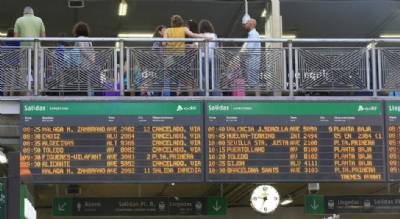
Train cancellations due to Wednesday's planned strike
Train cancellations due to Wednesday's planned strike
RAIL board RENFE has announced it will have to cancel 1,152 trains due to scheduled summer strikes, and urges travellers to review their journey plans.
The first of four days of industrial action planned between now and September will be this Wednesday (July 31), and the outer suburban links – known as Rodalies or Cercanías – will only be operating at 40%.
The next strike day is on August 14, on the eve of the national public holiday on August 15, followed by two more on August 30 and September 1 – each designed to coincide with the busiest summer holiday exodus and return.
Spain's ministry of public works has stipulated minimum services of 75% of all scheduled trains must continue to run at rush hour, and for Cercanías, 50% off-peak.
Medium-distance trains will be required to run 65% of programmed journeys, high-speed AVE lines 78%, and goods trains at 25%.
Union CGT has criticised the minimum service requirement, saying it is too high and is based upon passenger numbers from two years ago, which were much greater.
It argues that even in the worst-case scenario, the usual, reduced level of minimum services would mean travellers were 'only delayed by two to four hours' and that 'many would get there early' if they were 'placed on an earlier train'.
Strikes will be held between noon and 16.00 and from 20.00 to midnight on each of the four days.
Employees are protesting against outsourcing, staff who have left or retired not being replaced, and a lack of opportunities for in-house promotion and a poor work-life balance.
On a typical day, RENFE operates 3,500 Cercanías trains from Spain's largest cities to towns and villages in their wider provinces, about 600 medium-distance trains and 382 AVE and slower long-distance connections.
Due to the strikes, a total of 477 medium-distance trains have been cancelled, 230 AVEs and long-distance links, and 445 goods trains.
RENFE has not detailed any Cercanías links which have been cancelled, although with minimum service of 40% to 50%, it is likely journeys will take much longer.
The rail strike does not affect metro services in cities which have these, since they are operated by separate public-sector firms and fall within the jurisdiction of the local council.