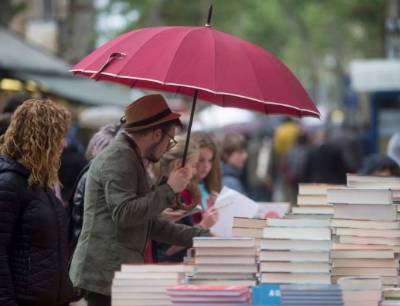
'Saint George's Day' book and flower fair moved to July
'Saint George's Day' book and flower fair moved to July
SAINT George is not just the patron of England – among the other regions and countries where the mythical dragon-slayer is celebrated on April 23 is Catalunya, where he is known as Sant Jordi and his 'day' fills the streets with book and flower stalls.
The former marks International Book Day, which also falls on April 23 as this was the date, in 1616, when Don Quijote author Miguel de Cervantes and British poet and playwright William Shakespeare died.
In practice, Cervantes passed away – aged 69 – 10 days before Shakespeare, who was just 52; although the dates are both recorded as April 23, 1616, England was still using the Julian calendar, whilst Spain had already moved onto the Gregorian calendar, the one used in most of the world today.
Long-standing tradition has it that on Sant Jordi's Day in Catalunya, people would give their partners or spouses a rose.
The two combined eventually, and it is now customary to buy your loved ones a flower and a book on Saint George's Day.
About six million red and yellow roses are sold in just one day in the north-eastern region, and many towns will have open-air flower and book stalls on the street.
The most famous Sant Jordi fair is in Barcelona, where top national and international authors sign their books – Siri Hustvedt and Marian Keyes have been among them in recent years.
Now, though, with Spain in lockdown due to the Covid-19 outbreak, the entire country's entire festival calendar has been shifted – and Sant Jordi will be celebrated on July 23 instead.
Cancelling it altogether would not only cause massive disappointment, but also put paid to a large slice of florists' and book shops' annual income, since they make several months' worth of profits on that one day.
'Social distancing' will still largely be in force by mid-July, even though quarantine is expected to be over, but book sellers and florists have guaranteed they will take steps to protect the public's safety.
And, in practice, Catalunya could end up having two Saint George's Days – florists and book shops are encouraging people to celebrate their regional patron indoors, by ordering flowers and reading material online for April 23.
About 100 florists, mostly small, family-run shops or one-person outfits, have opted not to sell flowers online next Thursday as they are concerned they will not be able to avoid the risk of Covid-19 contagion.
But even though this spring is likely to be hard on florists, it could be that they actually end up having a bumper year – whilst it is estimated that, even if some opt to sell flowers online, they will not shift even a quarter as many as they usually do on April 23, it is likely that those who had been looking forward to the usual street fair will plunge into the July one with renewed enthusiasm.
Moving fiestas to later in the year may seem unprecedented, but is in fact nothing new in Spain and not even because of extreme circumstances such as a pandemic.
Many festival organisers hold 'half-year' versions – medio año, or in Catalunya and the Valencia region, mig any – which are a low-key repeat of the event at the six-month anniversary.
About a decade ago, for the first time in its history, the nationally-popular pre-Lent Carnival in the Alicante-province village of Pego was rained off, leaving revellers devastated – particularly those who had spent months working on their costumes.
Pego town council opted to hold it in summer instead, exactly six months on – and this has since become known as the 'half-year Carnival', or Mig Any Carnestoltes, and continues to be held to this day in addition to the main event the last Saturday night before the start of Lent.