
Air travel's 'green' future: Why food-waste fuel is a long-haul project
Debate over banning short-distance flights takes off, but the cons outweigh the pros
Sign in/Register
Looking for the Professionals/Advertiser Login?
By Signing up you are agreeing with our Terms and Privacy Policy.Forgot your password?
Feedback is welcome


A community clear-up arranged by environmental charity Mi Moana and underwater 'rubbish patrol' team DivingWithNic, the event was sponsored by local businesses including SpecSavers, TOGI Data and Ecocean Green Solutions.
Mi Moana upped its current rubbish-clearance total by 10% in just one day: Since the charity was founded, it has scooped three tonnes of mostly-plastic waste off Fuengirola beach, of which 300 kilos were bagged up at the weekend.
Everything that could be recycled was deposited in the 'yellow bins' – for plastics and aluminium – the 'blue bins' for paper and cardboard, and the bottle banks.
Drinks cans, bottles, crisp packets and even broken bits of fishing line were among these, but unfortunately, the disposable masks and cigarette butts had to go into landfill.
The former, although made largely from plastic fibre, cannot be placed in recycling banks because they may be infected with viral particles, putting those who handle and sort the refuse at risk.
And masks are becoming one of the biggest sea-pollution culprits, adding to the existing proliferation of plastic that finds its way into the world's oceans – and which can even reach rivers and coastal waters when dumped on streets and in open-topped bins several kilometres inland.
They are quite possibly an even worse problem than plastic waste in general – the latter, when fished out of the sea, can be recycled, but masks cannot.
Mi Moana's co-founder Natasha Wegloop referred to a recent report of a penguin perishing after swallowing a mask floating in the sea.
She says since the pandemic hit Spain, beaches have been accumulating more and more rubbish, particularly masks, disposable gloves, and hand-sanitiser bottles, meaning Mi Moana has its work cut out.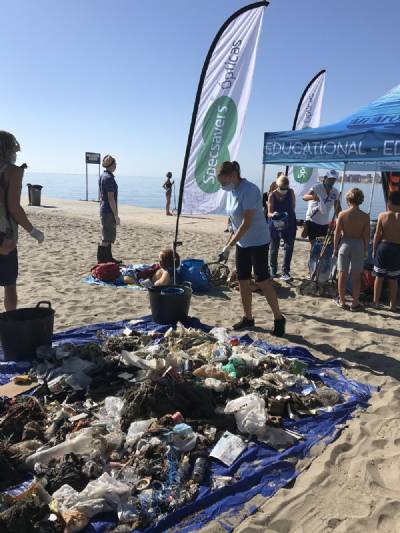
As well as protecting animals and marine plant-life in general, keeping the seas free from plastic pollution to stop underwater ecosystems being suffocated will keep the oceans 'alive', and as these supply between a half and three-quarters of the planet's oxygen, their good health is vital just to enable everyone on earth to breathe.
Also, dumping personal protection gear on streets and beaches creates a contagion risk, not just an environmental one.
SpecSavers in Fuengirola has been following EU guidelines on reducing use of disposable plastic – to cut down on the amount discarded indiscriminately rather than properly recycled – for over a year now, by axing plastic carriers from its shop.
Customers can also recycle their spectacles when these are no longer suitable, thanks to a Lions' Club scheme – and SpecSavers has offered all beach-clearing volunteers 25% off a new pair of glasses from its €89 range.
These include people who took part in the clean-up campaign on Saturday, and anyone else who helps or has helped Mi Moana with its work for the rest of the year (email customer.fuengirola.es@specsavers.com to claim your discount).
If you're on the Costa del Sol and want to get involved, you can find Mi Moana on Facebook.
And if it's good enough for royalty, it's got to be a cause worth joining: King Felipe VI's mother, Queen Sofía, joined in a mass volunteer clear-up on Málaga's Cala del Moral beach in September.
First photograph (left to right): Natasha and Nicky Wegloop, founders of Mi Moana; Nicoli Unt from Diving with Nic; David Bradshaw and Julie and Lauren Prince from SpecSavers opticians' in Fuengirola
Debate over banning short-distance flights takes off, but the cons outweigh the pros

BATTERIES from mobile phones, laptops and even cars are among those that must be recyclable within the next four years in accordance with a new European Union regulation, as explained by Spain's minister for...

ELECTRICITY could become cheaper to use at more convenient hours in a hypothetical about-turn for household bills – and that's thanks to solar power.

YET again and for the 36th year running, Spain holds the record for the highest number of blue-flagged beaches in the world, with its east-coast region of the Comunidad Valenciana having more than any other.