Two Royal birthdays: How Spain's past and future Queens celebrated
Two Royal birthdays: How Spain's past and future Queens celebrated
THE HALLOWE'EN and All Saints' Day period is, for Spain's Royal family, a double birthday celebration – for two Queens, one past and one future.
Princess Leonor of Asturias turned 15 on Saturday (October 31) and her paternal grandmother, Queen Sofía, turns 82 today (Monday, November 2).
With the current global health crisis, neither held a party – and in fact, the younger of the two would have been at school if her birthday had not fallen on a weekend, and the elder of the two was involved in her non-stop charity agenda across the country.
Leonor: 15 years since the Royal 'Hallowe'en Baby' hogged the headlines
It seems no time at all since the nation was waiting with bated breath to hear about the Royal birth a year and five months after Crown Prince Felipe of Asturias married journalist and TV news reader Letizia Ortiz – and when Leonor came into the world in 2005, she sparked an immediate amendment to the Spanish Constitution: The then socialist president, José Luis Rodríguez Zapatero, altered the text to allow a first-born female to be heir to the throne, meaning that if the new baby later had a younger brother, he would not leapfrog her to the Crown just because he was a boy.
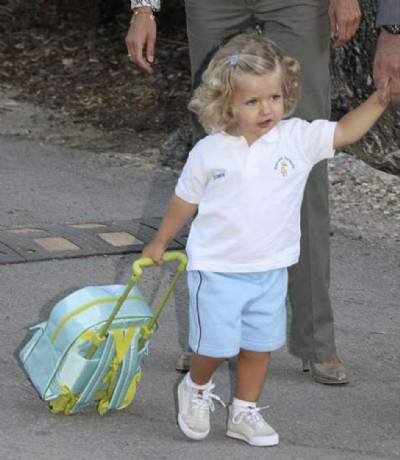
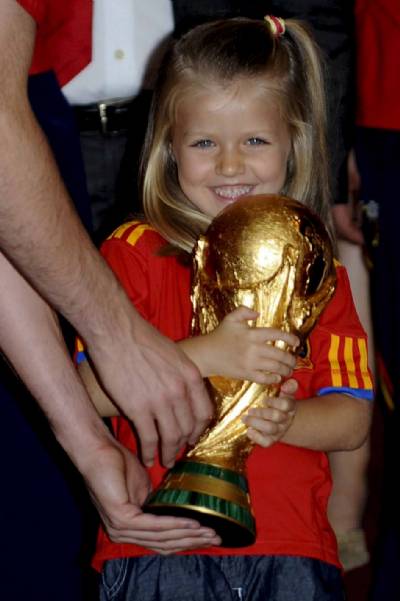
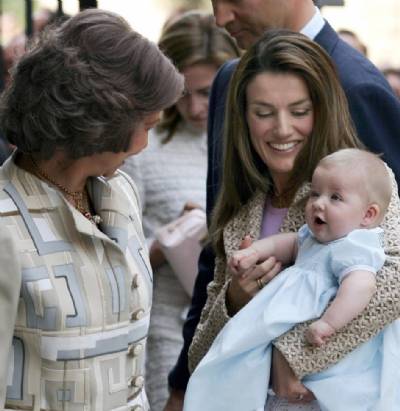
She became Spain's most-photographed tot of the 21st century, with pictures of the cute, round, blonde-ringleted Royal almost guaranteed to sell magazine copies – wrapped in white blankets as she and the then Princess Letizia left Madrid's Clínica Ruber, where Leonor's father was born; at her christening in the Zarzuela Palace; on her first day at playschool in the centre's uniform – a short-sleeved white polo shirt with the nursery's logo, and pale-blue fleece-lined shorts; aged one-and-a-half, meeting her new baby sister Sofía on May 3, 2007; the two little blonde sisters in Spanish national team football shirts, being given the World Cup by goalie Iker Casillas after the country's epic, first-ever win in South Africa; and the day she became the Princess of Asturias, in summer 2014 as her father was crowned King Felipe VI following his father, Juan Carlos I's abdication.
Leonor was just eight years old then, but the day her grandfather gave up the throne and her father took it from him meant her little life raced up a gear: It was a matter of time before she began to appear at public engagements, make speeches, write her own speeches, write and make speeches alone without her parents' presence or supervision.
Quite daunting enough for a schoolgirl, but knowing from earliest childhood that she was destined to become Head of State no matter what else she might have wanted to try out as a career would have been enough to terrify the vast majority of kids.
Especially as Leonor will be required to undertake military service – almost certainly when she reaches 18 and before heading off to university – since, once she becomes Queen of Spain, she will automatically become the highest-ranking officer in the Armed Forces.
The first time Crown Princess Leonor spoke in public was with her father beside her, on her 13th birthday, when she read out Article 1 of the Spanish Constitution, but the first time she recited a speech she had drafted herself – albeit probably with plenty of guidance from her parents – was when she was 14, at last year's Princess of Asturias Awards.
Leonor was the reason why the Prince of Asturias Awards had to be renamed, in the feminine, for the first time in their history.
Although her parents had broken it to her gently over many years about what lie ahead for her, Princess Leonor has long been, necessarily, mature and grounded beyond her age – a fact that came to light during the State tribute to Covid-19 victims earlier this year, when she discreetly pointed out to her father the King that his mask was sliding off.
She already has a 'life plan' drawn up for her, which is set to mirror that of her father – after she finishes at the Santa María de los Rosales private school in Madrid, which her sister the Infanta Sofía also attends, and following her military service, she is likely to spend some of her university years abroad.
King Felipe VI spent his final year of sixth form in Canada, and after graduating, studied a master's degree at Georgetown University in Washington – meaning he is fluent in English, as is Queen Letizia.
Princess Leonor and her sister are also fluent in English and have spent at least one summer at a camp in the USA to hone their language skills; Leonor, additionally, speaks French, which her parents would have learnt at school in preference to English, and she is said to have started learning Arabic and Mandarin Chinese.
Assuming all the monarchies in Europe continue in place for the next two to four generations, Leonor is one of a handful of future Queens on the continent – she is likely to be reigning at around the same time as tomorrow's Queens of Sweden, Belgium, Norway and The Netherlands.
Overall, despite her unusual life, her parents have tried to instil as much normality into Leonor as possible – as a very small child, she asked them why 'everyone kept staring at her' as she was picked up from school, and was told this was because her grandma and granddad were Queen and King of Spain.
She has always attended a school – the same one since age three – rather than being home-educated in the Palace, as would-be monarchs before her have, and her First Communion lacked any of the pomp and circumstance with which most children celebrate: No brand-new party dresses bought for the occasion, no piles of expensive gifts or family receptions with hundreds of guests wearing designer outfits; instead, Leonor was confirmed in a group along with all her other classmates, wearing school uniform, and went home to an ordinary family dinner.
This – in much the same way as King Felipe's 'crownless' coronation, which was a mere swearing-in ceremony – was designed to be as austere as possible so as not to 'rub it in' at a time when Spain's unemployment and poverty rates were worryingly high.
'Queen Mother' Sofía, 82, spends her birthday visiting food banks
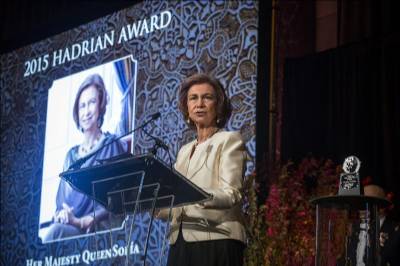
Leonor's grandmother, Queen Sofía – after whom the Infanta Sofía is named, a show of gratitude by Queen Letizia for her mother-in-law's invaluable support when she first joined the Royal family – spent her 82nd birthday continuing with her tour of the food banks she sponsors nationwide.
The 'Queen Mother' shelved her official engagements this year due to the pandemic, but has continued to spend practically all her time 'unofficially' helping out with the charities she either supports, or founded.
She has visited food-bank stores in the provinces of Albacete, Ciudad Real, Toledo, Murcia, the Gran Canaria city of Las Palmas, and the island of Lanzarote, and plans to visit the ones in Valencia and Sevilla this month if the Covid-19 situation allows.
Smiling behind her compulsory mask, Queen Sofía – who is said to be in very good health, for 82 - has been seen chatting with food-bank managers and volunteers to find out more about what they do, and has called them 'heroes'.
“She's a delight. She greets everyone with a smile, and acts totally naturally, with class and savoir faire,” said chairman of the Spanish Federation of Food Banks (FESBAL), Juan Vicente Peral, who is accompanying the 'Queen Mother' on her tour.
At each food store, she has been given a small souvenir such as a wristband or a badge, and immediately puts it on and thanks them for it, Peral explains.
Queen Sofía instantly attracts the public's affection wherever she goes, says the FESBAL chairman, because of her informal, friendly attitude and the way she treats everyone as important, and as an individual.
Given that the pandemic is making life particularly hard for bar-owners and restaurateurs nationally, Queen Sofía has pointedly paid visits to eateries and cafés wherever she has been on her food-bank tour, and was reportedly spotted in restaurants in Murcia and Toledo, sampling the local dishes.
Earlier this year, she was seen helping volunteers clear up rubbish from a beach in Málaga, joining in the release of a sea turtle in Mallorca – after it had been rescued, injured, and nursed back to health – and attended the Princess of Asturias Awards ceremony in the northern city of Oviedo on October 16, to support her son, daughter-in-law and granddaughters.
Queen Sofía's husband, King Juan Carlos I, has been out of the country for at least three months and is rumoured to be in the Middle East – a departure which caused widespread outrage, given that it came just as he was formally placed under investigation for a multi-million 'backhander' scandal involving the Spanish high-speed rail network to the holy city of Mecca, the Saudi King, various tax havens, and the former Countess-by-marriage Corinna zu Seyn-Wittgenstein.
The latter, who now goes by her maiden name of Corinna Larsen, is a close friend of Juan Carlos I's, although the gossip press claims she is more than that.
In an interview with OKDiario, Corinna says she has 'never considered herself' as a 'love-rival' to Queen Sofía, since the monarchs 'had been separated for 30 years'.
Sources close to the Royal family claimed several years ago that Juan Carlos I and Queen Sofía lived in separate wings of the palace, never saw each other except when they attended official engagements together, and only ever communicated through their secretaries.
Even though Juan Carlos I, also 82, has fallen from favour, his lack of popularity is largely among younger adults: Those who were old enough at the time remember how he took advantage of his nomination as Head of State by dictator General Franco to turn the nation around and bring about the Transition to democracy, drawing up and signing the Spanish Constitution to enshrine residents' rights and freedoms in black and white, and put an end to the 37-year hell the country's inhabitants had been through during the post-Civil War régime.