
MANCHESTER United goalkeeper David de Gea and Eurovision singer Edurne are set to become parents for the first time, according to the latter's social media posts.
Somehow, despite the fact Edurne, 34, works in her native Madrid as model, TV presenter, actress, singer and songwriter, and her partner, 29, lives and works in the north-west of England, they have managed to spend enough time together to realise their joint dream of starting a family.
In truth, much of Edurne's time off-screen and away from the cameras is spent in the UK with De Gea, whom she has been in a relationship with for 10 years.
It is not clear how far Edurne is into her pregnancy, but as sources close to the couple say the baby is not due until next year, she will be less than seven months at present.
Neither is it known whether they have found out if they are having a boy or a girl, or even if they want to know in advance.
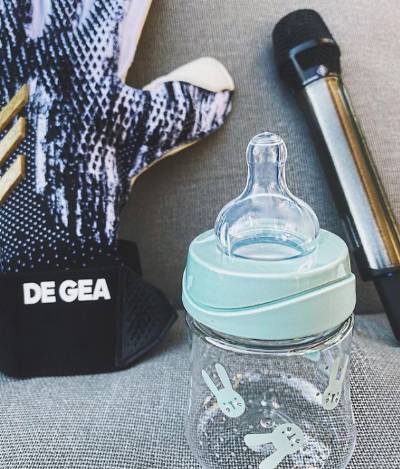
On her Instagram page, @edurnity, Spain's 2015 Eurovision Song Contest candidate posted a photograph of De Gea's goalkeeper gloves, her own microphone, and a baby bottle – a blue one, although this may not necessarily be significant as yet.
She has included the hashtag #BabyIsComing, and at the time of publication, had already netted 154,030 'likes' and numerous congratulatory comments from fans and fellow celebrities alike, including presenters Risto Mejide and Noemí Galera.
Edurne's part in Spain's disappointing Eurovision history
Edurne García Almagro, who will turn 35 just three days before Christmas, was already an established mainstream chart singer before she represented her country at the Eurovision five years ago, a contest where, despite a number of quality entries and experienced professional performers over the years, Spain has long suffered disappointing results.
In Edurne's case, she came 21st, a similar position to many other Spanish candidates in the last two decades.
The best placing in recent history was in 2012, when nationally-famous flamenco-pop singer Pastora Soler came 10th.
Spain has not won the Eurovision since 1969, although it has come second on four occasions since 1971, the most recent being 25 years ago, in 1995.
The country has only won it twice – the first time being in 1968 with Massiel singing La, La, La.
And its win the following year, with Salomé performing Vivo Cantando ('I Live Singing'), was in fact shared with three other nations: Lulu with Boom Bang-a-Bang (UK), Frida Boccara with Un Jour, Un Enfant ('One Day, One Child') for France; and Lenny Kuhr with De Troubadour ('As a Troubadour') for The Netherlands.
That year, Austria declined to send an entry, as a protest, based upon the fact that the host country, Spain, was still under a dictatorship – and would be for another six years until the death of General Franco.