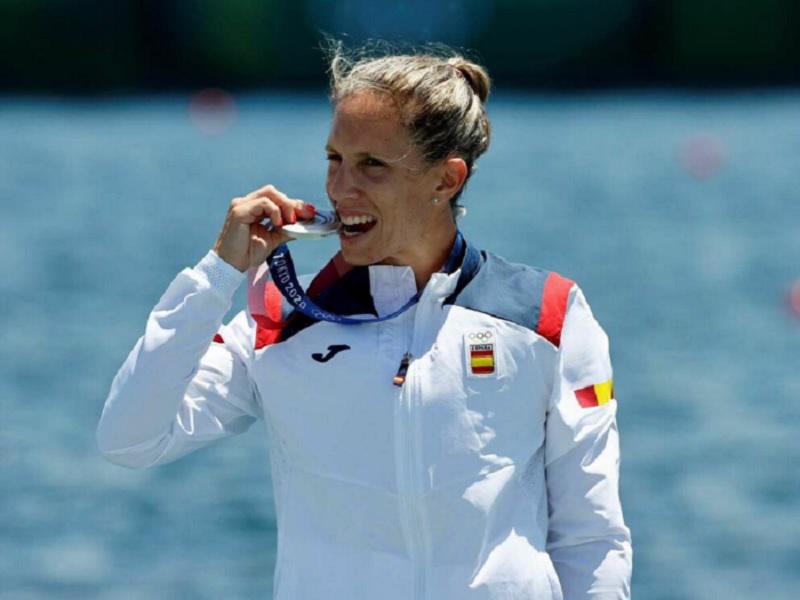
Teresa Portela gets her long-awaited silver in kayaking at her sixth consecutive Olympics
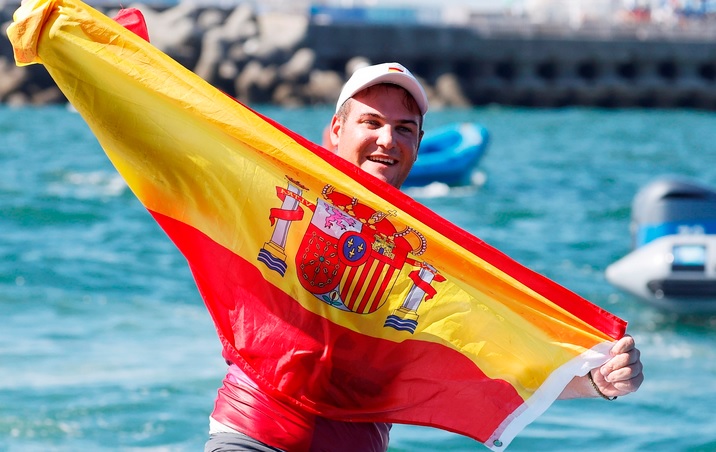
The latest, the country's first in sailing, was a bronze for 23-year-old Joan Cardona from Menorca and the ninth so far for Spain, putting the nation into 32nd place in the rankings in Tokyo 2020.
Up against Joan Cardona, Brit Giles Scott repeated his performance from Rio 2016 with a gold and Hungary's Zsombór Berecz took the silver in the men's Finn category finals, which the top 10 competitors – including Joan, who was sixth – qualified for on Tuesday.
The Royal Palma Yacht Club member was in ninth position out of the 10 until the final buoy, when a sudden surge took him up to third place and gave Spain its fourth medal in Finn sailing – the last it will win at an Olympics, since it is being scrapped from the agenda ahead of Paris 2024.
Joan Cardona celebrates his bronze in sailing
Previous medallists in the men's Finn category are José Luis Doreste at Seoul 1988 and José María van der Ploeg at Barcelona 1992, both golds, and Rafael Trujillo at Athens 2004, with a silver.
On the same day, Teresa Portela, competing in her sixth consecutive Olympic Games, took the silver in women's K-1 kayaking 200 metres after a near-photo finish with New Zealand's Lisa Carrington, in a time of 38.883 seconds, ahead of Denmark's Emma Aastrand Jørgensen who earned the bronze after beating Poland's Marta Walczykiewicz, whose time of 39.170 seconds earned her a fourth-place diploma.
Teresa, 39, from Cangas do Morrazo in the province of Pontevedra, in the far north-western region of Galicia, holds five Olympic diplomas – she came fifth at Athens 2004 in the K-2 canoeing 500 metres (pairs) and the K-4 canoeing 500 metres (team of four), and again in the latter in Peking 2008, then came fourth in the individual K-1 canoeing 200 metres at London 2012 after missing the podium by just 0.0198 seconds, and sixth at Rio 2016 in the K-1 canoeing 200 metres.
Her first Olympics, Sydney 2000, saw her come away without a diploma, and her persistence has paid off, adding the only 'missing' medal to her huge collection and only being beaten by the New Zealand prodigy who has won the gold in three consecutive Games.
Teresa has already won six silvers, seven bronzes and two golds in world championship team, pairs and individual events in the past 20 years, and from 2001 to 2013 inclusive, a total of four silvers, six bronzes and seven golds in European championships in K-1, K-2 and K-4.
Hers is Spain's eighth medal at Tokyo 2020.
The sixth, a silver, went to gymnast Ray Zapata, 28, in men's floor – resident in Las Palmas de Gran Canaria and a Spanish citizen, he was born in the Dominican Republic and his first Olympics for Spain was Rio 2016 - and the seventh went to 25-year-old athlete Ana Peleteiro, in the triple jump, a bronze.
Theirs are the first Olympic medals for Spain to go to black competitors, although the country has had several black élite sports personalities in its history, male and female, winning medals at other levels, including Niurka Montalvo who took the gold in high-jumping at the world championships in Sevilla in 1999, but who was banned from competing in the Sydney Olympics the following year by the Cuban Athletics Federation.
Mirroring the 'fist in the air' of México 1968 which got the USA's silver medallists John Carlos and Tommy Smith thrown out of their national team, Ana Peleteiro and Ray Zapata have been criticised by the far-right for their reference to race in a post-podium interview – although the International Olympic Committee only bans 'political expression' during competition or prizegiving ceremonies – and have been championed by left-wing supporters.
Leftist independent party Podemos' Juan Carlos Monedero said on Twitter: “It's curious how, when the Spanish flag is identified with something so beautiful [an Olympic medal], the far-right gets indignant about it.”
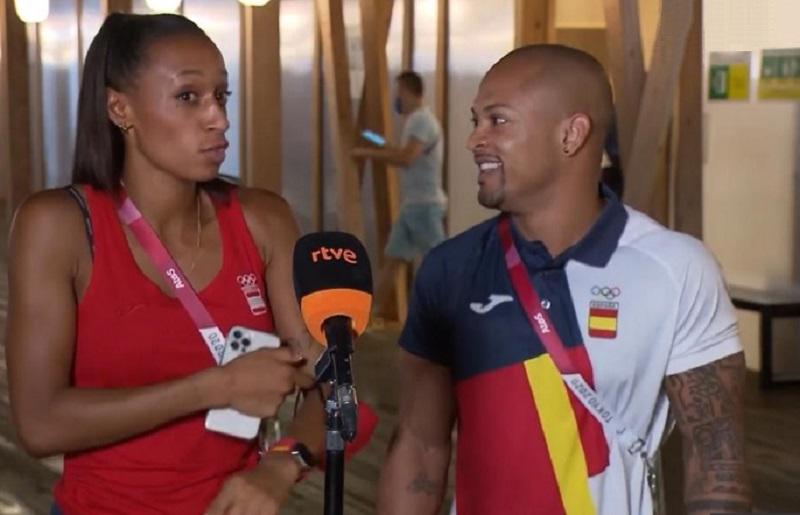
Ana Peleteiro (bronze in triple jump) and Ray Zapata (silver in men's floor gymnastics) are interviewed on television (photo: Screenshot from Spain's national broadcasting company, RTVE)
During the interview, Ray Zapata referred to himself and his good friend Ana Peleteiro as 'people of colour', which she swiftly refuted.
“We're not 'people of colour', we're black. It's the others who are 'people of colour' – they change colour more often than the sun does,” she argued.
Born in the province of A Coruña, Ana describes herself as 'half-Galician, half-black', and called herself on TV 'a cross between a Galician woman and an African guy from I don't know where'.
They both said on Spain's main broadcasting channel RTVE that they hoped their Olympic medals would be seen as 'the epitome of integration', and Ana said that although Ray was born in the Dominican Republic, he is 'more Canarian than bananas'.
Now she has become nationally – and globally – famous, a tweet published by Ana a year ago has been revived and gone viral.
Leader of far-right party Vox, Santiago Abascal, had announced dates for political rallies in Galicia's provincial capitals and other large cities in July 2020, to which Ana replied: “Best you stay at home. The only thing in Galicia that's green [Vox's party colour] are the mountains. You're welcome.”