Best-ranked Roscón de Reyes and cava: Consumer group gives its verdict
Best-ranked Roscón de Reyes and cava: Consumer group gives its verdict
EVEN though the festive season is now over for most of the world, the great news for anyone spending the holidays in Spain is that the country makes use of the full 12 days of Christmas – presents are given on the night of January 5 when the Magi parade through towns, or the Three Kings, as they are known uniquely here, and the following day is a public holiday.
Roscón de Reyes, a sweet treat to celebrate the arrival of the Magi, or ‘Three Kings’ (photo: Flickr)
Which means there's more celebrating to be done in Spain, despite New Year's Eve being behind us.
And for January 6, or 'Three Kings day', two key ingredients make up these celebrations: Roscón de Reyes and cava.
A Roscón de Reyes is a huge, circular cake, made from doughnut-like pastry, topped with candied fruit and sugar and, sometimes, cut in half and filled with cream.
And although cava is often treated as a poor relation to champagne and prosecco in Europe, a good-quality version can cost at least a week's salary – so it's definitely not, despite its unfortunate international reputation, a 'bargain basement' alternative to the 'real thing'.
Cava, the traditional way to toast the festive season in Spain (photo: OCU)
That said, as cava is home-made from nationally-grown grapes, it does not have to be expensive and, as is often the case with Spanish wines sold within the country's borders rather than imported, price does not always bear any relation to flavour and quality. It's perfectly possible to spend very little and still get a very decent cava to mark the passage of Balthazar, Casper and Melchior this coming Friday.
One of Spain's leading consumer organisations, the OCU, gives its verdict every year on which are the best supermarket-bought Roscones de Reyes and cava – and, as these differ annually and prices vary, it is always worth checking which makes the cut before purchasing.
The group analysed nine Roscones and 25 brands of cava, and has revealed which are its top two of the former and the best two for under €3 among the latter.
Cava with a price tag worth celebrating
Not just any sparkling white wine can call itself cava – only those eligible to bear a certificate of origin – and these only apply to cava produced in certain areas of Spain; if they are from anywhere else in the world, they cannot legally be sold under this name.
The OCU analysed alcohol and sugar content, acidity, presence of preservatives such as sulphites or other additives like ascorbic acid (vitamin C), which should not be necessary if the process has been correctly followed whilst making the drink.
Cava costing under €3 a bottle is worth celebrating in itself - whatever the occasion (photo: OCU)
A panel of expert oenologists, specialists in cava-tasting, also gave their views on flavour and quality.
One of the best two came in at a mere €2.19 a bottle, and comes from German supermarket chain Aldi.
Vinart Semiseco, a medium-dry, earned 85 points out of a possible 100 and is described as having 'intense aromas' with 'notes of bakery and white fruits', plus fine and 'continuous' bubbles.
A good balance of sweet and dry, the Vinart Semiseco cava is straw-coloured, according to the OCU's description.
For those who prefer a dry version, Vinart Brut also comes highly recommended for its quality in relation to price, the OCU says.
Another top-ranked dry cava is Cabré & Sabaté Brut, which costs just €2.20 and comes from the supermarket chain Mercadona.
It scored a total of 83 out of 100, is straw-coloured with fine and continuous bubbles, and notes of bakery and stewed fruit, the OCU tasting panel reveals.
A sweeter version is the medium Cabré & Sabaté Semiseco, which the OCU says is also exceptional value for money.
Cabré & Sabaté Brut is just €2.20 at Mercadona (photo: OCU)
Some of the most famous and best-loved cavas – normally those seen on sale outside of Spain as well as at home – are Cordoniu and Freixenet, both from Catalunya; their cost varies according to where they are sold and the type and quality, but excellent varieties can be found with prices in single figures.
Generally, the average price of the 25 cavas the OCU analysed was under €6.20 a bottle for top brands, or about €2.60 for mass-produced types such as those found in supermarkets.
The most expensive were in region of €12 a bottle, according to the OCU's report.
For quality alone, without taking lowest-possible prices into account, the OCU recommends Vía de la Plata, Ondarre and Raimat for Brut Nature fans.
A selection of some of the highest-ranked, lowest-priced cavas, according to the OCU. These varieties were all recommended by the consumer organisation in 2020, when they cost under €4 a bottle (photos by OCU; collage by El Español)
This is the most dry type on the market, with no added sugar - containing only the residual sugar left over from fermentation in the bottle, which is normally less than three grams per litre.
Marginally less dry is the Brut, which has a very small amount of added sugar, giving the drink an overall content of between six and 12 grams per litre – among these, the best, according to the OCU, is the Faustino Brut Reserva.
Medium-dry, or Semiseco, has added sugar, normally giving the wine a concentration of about 32 to 50 grams per litre, and the Vía de la Plata is the OCU's number one of this variety.
Roscón de Reyes: The cream of the crop
Among the main criteria the OCU focuses on when rating Roscones is the quality of the cream, and its general verdict is that the better ones use fresh cream rather than a vegetable-fat-based substitute.
In all supermarket Roscones analysed, only those from Mercadona failed to use fresh cream, instead filling theirs with a substance made from palm, sunflower or coconut oil.
That said, for vegans, a filling using vegetable fats rather than dairy cream is exactly what they will be seeking, so the Mercadona Roscones frowned upon by the OCU could well fit the bill, depending upon whether the other ingredients in the cake are free from animal produce.
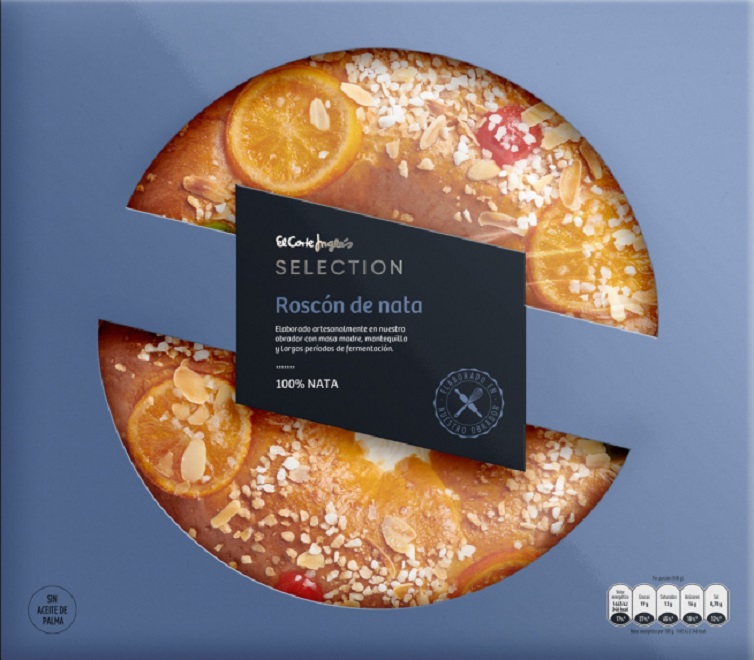
If you're not looking for the cheapest on the market, your best buy is the El Corte Inglés Selection Roscón, according to the OCU
Out of the nine examined and tasted, two were chosen as the best, with the King of the cakes being from department store El Corte Inglés.
The El Corte Inglés food hall is among the more expensive grocery-shopping venues in Spain, typically used by those seeking something special for festive or family get-togethers rather than those looking for ready meals for one after a long day at work.
Its Roscones come in at €17 per kilo, but if you're willing to spend a little more than at your usual supermarket, the quality justifies it – the citrusy tang in the dough, the delectable dairy cream, which makes up 40% of the Roscón, and the perfect balance of sugar and crushed almonds coating it makes the El Corte Inglés Selection variety a delicious choice.
The OCU also spoke favourably about its decoration, using glacée cherries and whole candied orange slices, but 'without strident colours'.
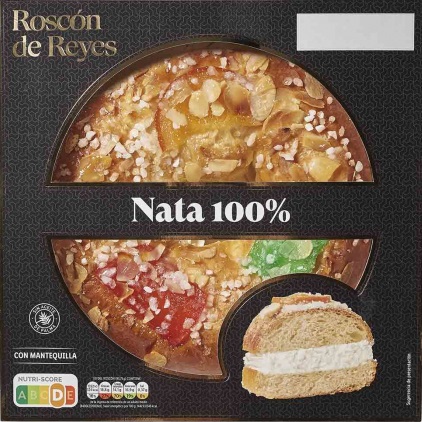
Lidl's La Cestera version is the best for those on a budget, the OCU says
Its filling is described on the label as '100% cream', and the packaging states it is free from palm oil.
Overall, and along with groceries in general, the cost of a Roscón de Reyes has risen sharply this year – around 24% - meaning prices have taken on greater importance in the OCU's annual review.
For those hoping to save money without buying a very inferior version, one of its cheaper recommendations – and the second of the organisation's top two – is only around half the price of the El Corte Inglés cake.
German supermarket chain Lidl is retailing Roscones at €7.99 per kilo – look for its 'La Cestera' brand.
The OCU assures it has 100% fresh cream, and has spoken positively of its decoration, with a colourful mix of candied fruit in traffic-light tones, topped with flaked almonds and sugar.
Lidl's Roscón has been highly ranked for its full flavour, given that it is made with real butter.