
- Property prices in Spain vs Italy
- Purchase taxes in Spain Vs Italy
- The buying process in Spain vs Italy
- Buying off-plan: stronger statutory protection in Spain
- Ongoing costs once you own the property
- Capital gains tax when selling: Italy's advantage
- Residency and tax schemes for movers
- So, which is easier and cheaper?
10 min read
For Italian buyers in particular, Spain and Italy are natural points of comparison — two Mediterranean countries with similar climates, comparable culture and cuisine, and a shared appeal as a place to buy a second home or relocate to. But the two property markets work quite differently in practice, from how taxes are calculated to how the buying process itself unfolds. This guide compares them honestly, covering what each country genuinely does well, so you can make the decision with a clear picture of both.
Property prices in Spain vs Italy
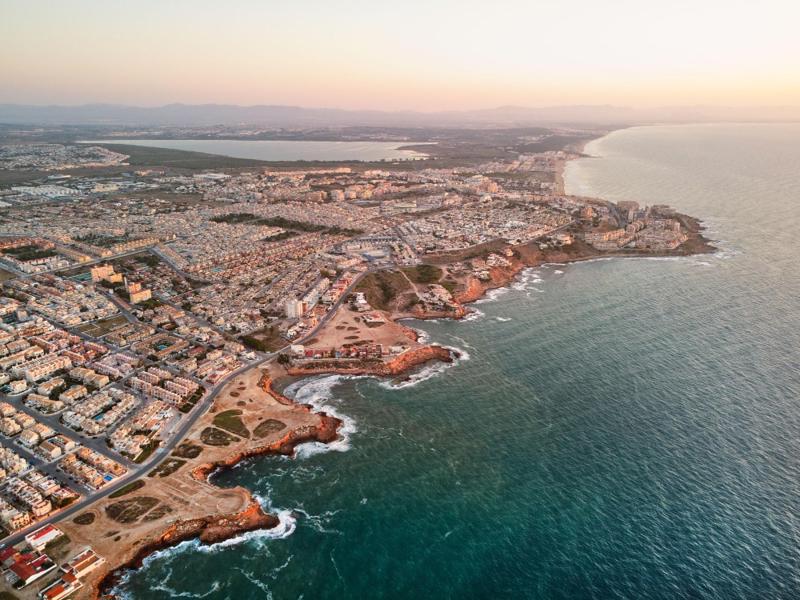
Neither country is uniformly cheaper than the other — both have expensive capitals and coastal hotspots alongside genuinely affordable regions. Milan, Rome, and the Amalfi Coast command prices comparable to Madrid, Barcelona, or Marbella. But where Spain tends to have an edge for the specific profile of buyer looking at this comparison — a second home or relocation on the coast — is the breadth of accessible, well-connected coastal inventory at moderate prices. Spain's Mediterranean coastline offers a far larger stock of modern, move-in-ready apartments and villas in established international communities, at price points that remain accessible even close to the sea, particularly along the Costa Blanca and parts of the Costa del Sol.
Italy's equivalent value is found more often inland or in the south — Puglia, Calabria, Sicily — where prices can be very low, but the property stock is older, renovation needs are often significant, and English or Italian-speaking international infrastructure is considerably thinner than on Spain's established coasts.
Purchase taxes in Spain Vs Italy
This is the area buyers most often misunderstand, because the two countries calculate tax on different bases entirely.
Spain
For a resale property, Spain applies transfer tax (ITP) directly to the purchase price — generally 6% to 10%, depending on the autonomous community. For a new build bought from a developer, VAT (IVA) applies instead, at a flat 10%, plus stamp duty (AJD) of roughly 0.5% to 1.5%. All-in closing costs for a resale in Spain — taxes, notary, registry, and legal fees — typically land between 10% and 14% of the purchase price. The full breakdown of Spanish property taxes covers regional variations in more detail.
Italy
For a resale property bought from a private seller, Italy applies registration tax (imposta di registro) of 9% for a second home — but crucially, this is calculated on the property's cadastral value (valore catastale), not the market price. Cadastral values are typically 30% to 50% lower than what a property actually sells for, so the effective tax burden on the real purchase price often works out to roughly 5% to 7% — lower than the headline rate suggests. A reduced 2% rate applies to a primary residence, but this requires transferring official residency to the property's municipality within 18 months, a condition most non-resident second-home buyers do not meet. New builds from a developer attract VAT instead, at 10% (4% for qualifying primary residences, 22% for luxury categories), on the sale price rather than cadastral value.
The practical difference
Once notary fees, agency commission, and legal costs are added on both sides, total closing costs in Italy for a non-resident buying a second home typically also land in the 10% to 15% range — broadly comparable to Spain once all costs are accounted for. The genuine difference is less about which country is cheaper overall, and more about predictability: Spain's tax is calculated on what you actually paid, which is simple to budget for in advance. Italy's cadastral-value system can work in a buyer's favour, but it requires understanding a valuation figure that is separate from the price on the contract, which adds a layer of complexity for a first-time buyer unfamiliar with the system.
| Purchase tax comparison — resale property, non-resident second-home buyer | ||
|---|---|---|
| Factor | Spain | Italy |
| Main resale tax | ITP: 6%–10% | Registration tax: 9% |
| Tax base | Purchase price | Cadastral value (often 30–50% below market price) |
| Effective rate on market price | 6%–10% | Roughly 5%–7% |
| New-build tax | VAT 10% + AJD 0.5–1.5% | VAT 10% (or 4% prima casa, 22% luxury) |
| Typical all-in closing costs | 10%–14% | 10%–15% |
Sources: Agencia Tributaria (Spain, ITP/AJD/IVA rules); Agenzia delle Entrate and Investropa (Italy, imposta di registro/IVA rules), 2026.
Figures are indicative and vary by region and property type in both countries. Always confirm current rates with a local lawyer or notary before budgeting.
The buying process in Spain vs Italy
Both countries require a foreign identification number before you can do anything else, and both typically take around two to three months from an accepted offer to completion — but the structure of the process, and who is responsible for protecting your interests along the way, differs meaningfully between the two.
Spain
You will need an NIE - foreigner identification number, which typically takes two to six weeks to obtain. The process then generally runs through a reservation, a private deposit contract contrato de arras, due diligence carried out by an independent lawyer, and completion before a notary. The notary in Spain authenticates the deed but does not represent either party — engaging your own lawyer is strongly advisable, since nobody else in the transaction is working exclusively in your interest.
Many buyers also use a gestor alongside their lawyer to handle the administrative side of the purchase — registering the deed and settling taxes after completion.
Italy
You will need an Italian tax code (codice fiscale) — the rough equivalent of the NIE. The Italian process is more centred on the notary (notaio), who is a mandatory public official responsible for verifying the seller's title, drafting the deed, and registering the transaction — a more built-in layer of verification than Spain's system provides by default. This makes the notary a more central figure throughout, though buyers still typically engage their own lawyer for contract review and due diligence, particularly if they do not speak Italian fluently. The full process from accepted offer to keys generally takes 60 to 90 days in both countries.
Which is genuinely easier
Spain is widely regarded as the more accessible market for international buyers specifically because of the maturity of its coastal property infrastructure: a much larger base of English and multi-language-speaking agents, lawyers, and administrators, particularly along the Costa Blanca and Costa del Sol, built up over decades of serving international buyers. Italy's process is well documented, and the notary system provides strong built-in legal protection, but the practical, day-to-day experience of navigating it — especially for a first-time buyer without fluent Italian — is generally considered to involve a steeper learning curve, particularly outside the most established international pockets like Tuscany or the Lakes.
Buying off-plan: stronger statutory protection in Spain
For anyone considering a new-build purchase before construction is complete, this is worth knowing: Spain has one of the more robust legal protection regimes in Europe for off-plan buyers. Under Ley 20/2015, developers are legally required to guarantee every advance payment individually, through a bank guarantee or insurance policy, before they can lawfully accept it — and only once the building licence has actually been granted. If a developer fails to deliver, the buyer can claim the full amount paid, plus interest, directly from the guaranteeing bank or insurer, rather than pursuing the developer through the courts. This protection is mandatory, not optional, and the developer bears the cost of it, not the buyer.
Italy has its own statutory protection for off-plan buyers, centred on a government-backed guarantee fund, but Spain's system — individually guaranteed payments tied to specific planning milestones, enforceable directly against a bank — is generally considered simpler for a foreign buyer to understand and rely on in practice. For anyone weighing a new-build purchase in either country, this is worth raising directly with a local lawyer before signing anything or making any payment.
Ongoing costs once you own the property
Both countries levy an annual municipal property tax: IBI in Spain and IMU in Italy. Spain's IBI runs from roughly 0.4% to 1.1% of the cadastral value, set by the local authority. Italy's IMU on a second home runs somewhat higher, typically 1.0% to 1.3% of cadastral value, also set municipality by municipality — and unlike a true Italian primary residence, which is largely exempt from IMU, a foreign-owned second home has no equivalent exemption in either country.
Both countries also apply annual non-resident income tax on property ownership, and both charge for shared building costs where relevant — community fees in Spain, spese condominiali in Italy — calculated similarly, based on the share of the building each owner holds.
Capital gains tax when selling: Italy's advantage
In the interest of a fair comparison, this is worth flagging clearly: Italy's capital gains regime for individual sellers is unusually generous. A property sold more than five years after purchase is entirely exempt from capital gains tax, regardless of the seller's residency status — no allowances to calculate, no taper, just a clean exemption. Spain has no equivalent blanket exemption of this kind for non-resident sellers, who generally remain liable for capital gains tax on any increase in value, subject to the applicable rate and any relevant double taxation treaty. For buyers planning to hold a property for the long term before eventually selling, this is a genuine structural advantage on the Italian side worth factoring into the decision.
Residency and tax schemes for movers
Neither country currently offers residency in exchange for a property purchase. Spain closed its real estate-linked Golden Visa route in April 2025; Italy has never offered one, and its Investor Visa requires investment in a startup, established company, government bonds, or a philanthropic donation — property purchase does not qualify in either country. Anyone considering a move should treat residency and property purchase as two entirely separate decisions.
For those actually relocating and becoming tax resident, the two countries offer very different incentive schemes aimed at different profiles of mover. Spain's Beckham Law allows qualifying new residents — employees, remote workers, entrepreneurs — to pay a flat 24% on Spanish-sourced income for up to six years, a scheme genuinely accessible to a working professional relocating for a job or to work remotely. Italy's flat-tax regime works differently: new tax residents can opt to pay a fixed annual sum (raised to €300,000 from January 2026) covering all foreign-sourced income, regardless of amount — a scheme built for high-net-worth individuals with substantial income from outside Italy, rather than for someone moving to take up local employment. In practice, the two schemes serve different audiences: Spain's is more accessible to a typical relocating professional, while Italy's is more relevant to a small number of very high earners.
So, which is easier and cheaper?
On cost alone, the two countries end up closer than the headline tax rates suggest — Italy's lower cadastral-value tax base offsets its higher-looking registration tax rate, and total closing costs land in a broadly similar range in both countries. Italy holds a genuine advantage for long-term owners thanks to its five-year capital gains exemption.
On ease, the comparison is more clear-cut. Spain's decades of experience serving international coastal buyers have built an infrastructure — agents, lawyers, gestores, multilingual services — that makes the practical experience of buying meaningfully more straightforward for most foreign buyers, particularly those without fluent Spanish or Italian. Combined with a larger stock of accessible, move-in-ready coastal property and a tax residency scheme genuinely open to working professionals rather than only the very wealthy, this is why so many international buyers — Italians included — continue to choose Spain over Italy for a second home or a relocation.
If you're ready to see what that looks like in practice, our step-by-step guide to buying property in Spain walks through the whole process from first viewing to completion.

Last updated: 27/08/2026
Was this article useful?
Related Topics
Related Articles