- What is the nota simple?
- What is the nota simple used for?
- Who can request a nota simple?
- How to get a nota simple
- What information does a nota simple contain?
- What a nota simple looks like
- How to read a nota simple
- What to do if the nota simple shows a problem
- How much does a nota simple cost?
- Nota simple checks for off-plan property
- Why you need a nota simple
9 min read
If you have started researching how property transactions work in Spain, you will have come across the term nota simple fairly quickly — it is one of the first documents any buyer, lawyer, or bank will mention. This guide answers the questions people most commonly ask about it: what it is, who can request one, what it actually contains, how to read it, and what it costs.

What is the nota simple?
The nota simple is an official informative extract from Spain's Registro de la Propiedad (Land Registry), summarising the key legal facts about a specific, registered property: who owns it, its physical description, and any debts, mortgages, or other charges registered against it.
It is important to understand what it is not: a nota simple is purely informative. It has no legal certifying value in court — for that, a different document, the certificación registral, is required. In practice, the nota simple is what almost everyone actually uses day to day, since it is faster, cheaper, and gives buyers, lawyers, and banks everything they typically need to assess a property before a transaction.
What is the nota simple used for?
- Confirming that the person selling a property is its genuine, legally registered owner
- Checking whether the property carries any mortgages, debts, liens, or other charges that could transfer to a new owner
- Verifying the property's registered description matches what is actually being bought — size, boundaries, and registered use
- Meeting a bank's requirement as part of the mortgage valuation process
Who can request a nota simple?
Spanish law allows anyone with legitimate interest (interés legítimo) in a property to request its nota simple. In practice, this is interpreted broadly and rarely creates a barrier — the Land Registry does not usually ask a requester to prove their interest in detail. Typical requesters include:
- Prospective buyers researching a property before making an offer
- The property's current owner, checking their own registered details
- Lawyers and gestores carrying out due diligence on a client's behalf
- Banks and mortgage valuers, as a standard part of the lending process
- Estate agents, when preparing a property for sale
You do not need to own a property, or even be in Spain, to request a nota simple on it. This is precisely what makes it such a useful early research tool — you can check a property's legal status before committing to travel, view it in person, or make an offer.
How to get a nota simple
There are three main ways to request one:
- Online: through the official Registradores de España website, which also lets you request the document in English or any of Spain's official languages
- In person: at the specific Land Registry office covering the area where the property is located
- Via a lawyer or gestor: most buyers simply ask their lawyer or gestor to request it as part of standard due diligence, typically for a modest additional fee on top of the registry cost
To request one, you will usually need at least one of the following: the property's CRU/IDUFIR (Unique Registration Code), its registry details (province, municipality, registry office, and plot or finca number), or the owner's full name and NIF/NIE. If you do not have any of these, the property can often still be located using its address via the
Registradores geoportal, a mapping tool that lets you identify a property's registry details from its location.
What information does a nota simple contain?
A nota simple is structured into distinct sections, each covering a different aspect of the property's legal status.
Property identification
Registry details (finca number, volume, folio, and the CRU/IDUFIR unique identifier), the property's registered description — address, surface area, and type — and, where available, its cadastral reference.
Ownership (titularidad)
The full legal name and NIF/NIE of the registered owner or owners, and if there is more than one, the percentage each holds. This section also shows how the current owner acquired the property — by purchase, inheritance, or donation — and when.
Charges and encumbrances (cargas)
Any mortgages registered against the property, including the lender and outstanding terms; embargoes or legal seizures; easements (servidumbres), such as rights of way or shared access; and any resolutive conditions or rights of first refusal that could affect a future sale.
Other status information
Official government guidance confirms the nota simple also states whether the property is up to date with community fee and IBI (property tax) payments, whether it is registered as officially subsidised housing (VPO) with resale restrictions, and whether its registry entry is properly coordinated with the Catastro (the separate cadastral/tax register) — discrepancies between the two are common and worth flagging to a lawyer if found.
Preventive annotations and historical notes
Any ongoing legal disputes or claims affecting the property appear here, along with a record of previous ownership transfers — useful background when assessing a property's history.
What a nota simple looks like
To make the structure above more concrete, here is an illustrative example showing the real layout published by Registradores de España, with entirely fictional data — no real name, property, or reference number is used.
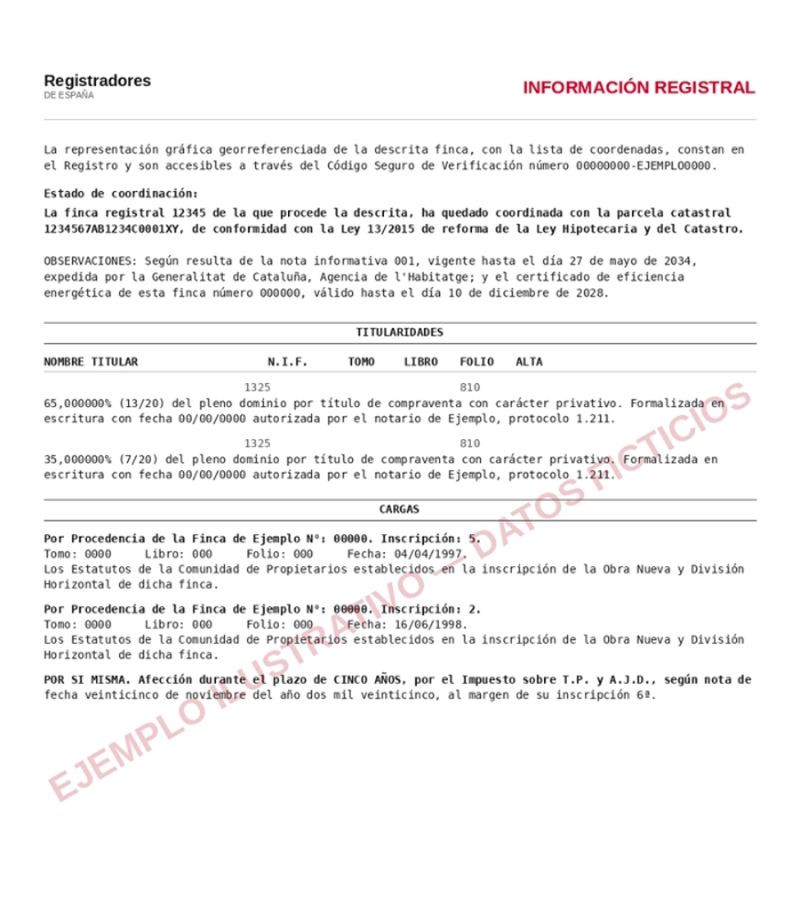
A few things worth noticing in this example: the ownership (titularidades) section shows two co-owners, with a 65% and 35% share respectively, both having acquired their share by purchase (compraventa). The charges (cargas) section here shows no mortgage — instead, it lists two standard references to the building's Community of Owners bylaws (Estatutos de la Comunidad de Propietarios), which appear on virtually every apartment's nota simple and are not a cause for concern, plus a routine tax affection notice (afección fiscal) that applies automatically for five years after any purchase, relating to transfer tax and stamp duty.
Not every nota simple looks the same: some will show an active mortgage in the charges section, others won't, and the specific entries always depend on that particular property's own history. This is exactly why reading the charges section carefully matters — a mortgage entry here would need to be addressed before completion, while community bylaws and standard tax notices generally do not.
How to read a nota simple
Once you have the document, a few checks matter most:
- Confirm the name of the seller matches exactly the registered owner shown in the ownership section
- Check the charges section carefully for any mortgage, embargo, or lien — these can transfer to a new owner if not resolved before completion
- Compare the registered surface area and description against what you are actually being shown — unregistered extensions or discrepancies are common in Spain
- Note any easements, which may restrict what you can do with the property even after you own it
- Check the date the nota simple was issued — request a recent one, as a property's status can change, and lenders will not accept one older than three months
The document uses standard Spanish legal and registry terminology throughout, which can be dense even for fluent Spanish speakers. This is one of the main reasons buyers work with an independent lawyer rather than interpreting it alone — a lawyer will not just read it, but understand what any flags mean for your specific purchase.
What to do if the nota simple shows a problem
Finding something concerning in the charges section is not necessarily a reason to walk away — but it does change what happens next.
- An active mortgage: this is common and manageable. Your lawyer can confirm the outstanding balance and arrange for it to be settled from the sale proceeds at completion, so it does not transfer to you
- An embargo or legal seizure: more serious, and worth pausing over. This means a debt or court order is attached to the property itself — clarify with your lawyer whether it can realistically be cleared before you would complete, and treat this as a genuine reason to slow down
- A name mismatch: if the person selling is not the name shown as owner, stop and ask why immediately — this may be entirely explainable (a recent inheritance not yet updated, for example) but must be resolved and evidenced before you go any further
- An easement or restriction you were not told about: ask specifically how it affects your intended use of the property, since some are minor and some are not
Whatever you find, deal with it before signing the contrato de arras — Spain's pre-sale deposit contract — not after. Once signed, walking away becomes financially costly, so any issue flagged by the nota simple should be resolved, or at minimum clearly addressed in writing, before you reach that stage.
How much does a nota simple cost?
The official fee, set by the Land Registry, is currently €9.02 plus VAT for a standard request. If you need it translated into English, this typically costs an additional €30 plus VAT. If a lawyer or gestor requests it on your behalf, expect a modest handling fee on top of the official cost — this is standard practice and reflects the time spent reviewing it, not just retrieving it.
Once requested, the document is typically issued within 24 to 48 hours and delivered by email as a downloadable link.
Nota simple checks for off-plan property
If you are buying a property that has not yet been built, the checks are more involved, since there is no finished property yet to describe. Government guidance recommends verifying, via the registry, that the developer legally exists and is properly registered, that the land to be built on is registered in the developer's name, and that the town council has authorised the construction with a valid licence. Once complete, a fully registered new-build entry should also confirm that mandatory defect insurance has been taken out and that the building's technical dossier (libro del edificio) has been filed.
Why you need a nota simple
In short: the nota simple is the single most direct way to confirm that a property is what it appears to be, before you commit any money to buying it. It protects you against the most common and costly risks in a Spanish property purchase — buying from someone who is not the legal owner, or inheriting debts attached to the property. For the fuller picture of registering your own purchase once complete, our guide to how to register a property in the Land Registry covers the next step, and our guide to the 10 documents to request from the seller places the nota simple in the context of everything else you should check before buying.

Last updated: 02/10/2026
Was this article useful?
Related Topics
Related Articles