Diplomatic immunity to be cut from 17,621 people to 22 and limited to official public duties only
Diplomatic immunity to be cut from 17,621 people to 22 and limited to official public duties only
DIPLOMATIC immunity for public figureheads in Spain is about to be heavily slashed, with the current 17,621 enjoying legal privileges falling to 22.
At present, politicians at State and regional level, judges and magistrates, prosecutors and other law-enforcers go straight to the Supreme Court when they are sued or accused of a crime, rather than having to go through the entire court hierarchy as ordinary citizens are obliged to do so.
The highest court in the land – except for the Constitutional Court, which only deals with interpretations of Spain's Magna Carta – requires far higher standards of evidence to convict a person appearing before it, meaning there is more chance that if a diplomatically-immune party is taken straight to the Supreme Court they will escape charges through lack of sufficient proof.
It also costs a vast amount of public funds to take a case to the Supreme Court, and cases are settled far more swiftly than when the local, provincial, regional and then national courts deal with them as the appeal process climbs the court ladder.
And the diplomatically-immune go straight to the Supreme Court for every charge against them, civil or criminal, right down to causing accidents through drunk driving.
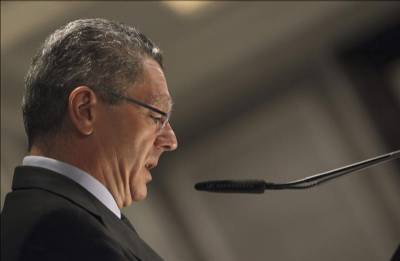
Justice minister Alberto Ruiz-Gallardón (pictured) says that if law-enforcers such as police officers are added to the list, the total number of people protected in this way rises to 280,159.
He says the situation needs to be urgently reviewed.
“Society has become much more demanding of its political class as a result of collective indignation over the dual reality of corrupt and criminal conduct and the tremendous financial difficulties faced by a major proportion of Spanish society,” he says.
“Ideally corruption should not occur – not because of administrative hurdles or the threat of prosecution, but because of officials' personal code of ethics.
“Unfortunately, that has not been the case, and I consider there has been a great decline in ethical standards of many public officials who represent a significant minority,” Ruiz-Gallardón said in a frank interview with El País in English, a national foreign-language broadsheet.
But the justice minister points out that diplomatic 'immunity' is not necessarily a privilege awarded to those at the top and denied to the ordinary citizen.
“Rather than being a privilege, it can in fact undermine one's fundamental right to get a conviction reviewed by a higher court,” says Ruiz-Gallardón.
When a person is convicted in a lower court, he or she can continually appeal until the court hierarchy has been exhausted – but those who are diplomatically-immune are tried just once and have nowhere to appeal if found guilty.
“But no matter how the jurists explain it, Spanish society perceives immunity as a privilege, and I think this requires action from lawmakers,” the minister told El País.
Secretary-general of the PP government María Dolores de Cospedal backs this view that there should be far fewer public figureheads who hold diplomatic immunity.
She also wants to take it a step further and limit this immunity to the person's official role, not to his or her personal life.
This means those who hold immunity would only go straight to the Supreme Court where criminal or civil charges laid against them related to their work as politicians – in the aforementioned case of a hypothetical accident they cause by drink-driving, they would go through the full court hierarchy from the bottom up in the same way as the rest of society.
And in Ruiz-Gallardón's view, diplomatic immunity should only apply to 22 people in the country – in addition to the Royal family of King Felipe VI and his wife Queen Letizia, his parents Queen Sofía and King Juan Carlos I, and daughters Princess Leonor and the Infanta Sofía when they come of age.
These would be the presidents of Spain's 17 autonomously-governed regions, the president of Spain – in this case, Mariano Rajoy – the speakers of Parliament, or Congress, and the Senate respectively, and the chairmen of the Constitutional Court and the Supreme Court itself.
“There would be no immunity for deputies, MPs or ministers, like myself,” Ruiz-Gallardón explains.
It was initially thought that to cut the number of diplomatically-immune parties from 17,621 to 22 and reduce this protection to cover only their public duties would require the Constitution – drawn up in the 1970s and untouched since – to be amended, the PP government said all it would take in practice would be an amendment to existing legislation.