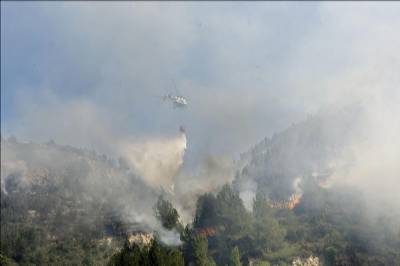
Pego-Vall d'Ebo fire flares up again; two homes burn down
Pego-Vall d'Ebo fire flares up again; two homes burn down
THE Costa Blanca's worst fire in over 20 years flared up again yesterday (Saturday) late afternoon and the road to the valley was cut off to traffic.
Pego (Alicante province) was surrounded by a ring of fire on Thursday – the hottest day in May in the Valencia region since 1869 – and Friday after a farmer in the Vall d'Ebo ignored warnings about the ongoing drought and extreme heat and lit a bonfire, which raged out of control.
At least 50 homes in the Los Verdales and Les Comes rural urbanisations and the residential area behind the stations of the cross, leading up to the hilltop chapel, in Pego had to be evacuated on Thursday and the main road leading from Pego to the Vall d'Ebo, on to Forna and then back to the town of Oliva in the northern Valencia province was shut.
Gas masks were handed out in Pego town centre and residents advised to stay indoors, although some who had to go out were seen holding wet towels over their faces.
All evacuees were told they could return home on Friday, but as the fire was still burning – albeit under control - many were reluctant to do so.
By Friday night, after 14 hydroplanes had been working constantly during every hour of daylight since Thursday lunchtime, the fire was completely out, although emergency services were continuing to spray the area with water in case sparks flared up again.
Yesterday at 16.30hrs, the flames broke out again, this time in the Barranco del Infierno – which translates as 'Hell's Ravine' – forcing firefighters on site to call in reinforcements for a second time.
During Thursday and Friday, two members of the Armed Forces Emergency Unit were injured, and two homes on the outskirts of Pego burnt down.
Interior and outside walls remained standing, but the doors were reduced to ashes and the windows melted, letting the flames inside and completely destroying the fixtures and contents.
One owner said he and his family tried to tackle the blaze in their house with hosepipes, but the flames beat them and they had to run for their lives.
When they returned the following day, the fire was still burning on their premises, even though the main inferno had backed off and was contained, and they put out what was left of the blaze on their property themselves.
Owners say there were no planes or fire engines within sight of their homes, and the only firefighting efforts involved to try to save them were their own.
Other nearby residents reported damage to the outside of their houses and to their land, with hedges burnt to a crisp, garden furniture and children's swings and slides totally destroyed.
The flames had begun to spread towards neighbouring Adsubia – home to thousands of expatriates, many British, on the Les Bassetes urbanisation – and the huge residential complex of Monte Pego, but did not get near enough for anyone to have to be evacuated.
A number of residents, including several Brits living in Pego's rural outskirts said they had packed a suitcase on Thursday and kept their pets indoors ready to flee at the drop of a hat.
Saturday evening saw the main Pego-Vall d'Ebo road shut again.
Planes had to stop work at nightfall on Saturday, although by then there were no flames – however, smoke continued to billow out of the Barranco del Infierno and at least 300 ground staff, including the fire brigade, forestry brigade and Armed Forces, continued to work on the area last night.
Regional government president Alberto Fabra (PP) visited Pego on Thursday and was physically attacked by a local man and jeered at by dozens of bystanders for the regional government's poor response to the disaster.
Witnesses say it took at least four hours after the fire was reported for hydroplanes to be sent in by the government in Valencia – and if they had been drafted in immediately, they would have been on site within a maximum of half an hour and the fire would not have spread to anywhere near Pego or any residential zones.
Last September's inferno on the Montgó mountain between Dénia and Jávea, just a few kilometres south of Pego, was then said to be the worst on record after 1,400 residents, including many expatriates, were evacuated and 444 hectares of land destroyed.
But this week's blaze has already wiped out 1,715 hectares – based upon an initial count, meaning the total could rise – and 20% of Pego's land has been reduced to ashes.
The vast, picturesque and verdant Vall d'Ebo, a barely-habited valley popular with local walkers and rural tourism fans from home and abroad and famous for the views across 'Hell's Ravine' and the fascinating million-year-old El Rull cave, is now a grim, lunar landscape – grey and coated with ashes as far as the eye can see and with black skeletons where trees used to be.
After a forest fire of this magnitude, it can take up to 30 years for the land to recover.
Building plots cannot be used for their purpose for 30 years after a fire, since a law was passed within the last decade to this effect to discourage unscrupulous speculators from setting fire to land and then buying the charred remains for a fraction of the price for development.
Pego council intends to investigate what went wrong at regional government level in terms of sending out emergency workers and planes in time.
The man who broke through the police barriers and tried to beat up the president, and another man charged with 'disobedience of authority' for trying to return to his house after being evacuated, will be given free legal assistance by Pego council.
Similar criticisms about hydroplanes and the Armed Forces being sent in way too late were heard after the massive Montgó inferno, both from residents and the local council.
On the Jávea side of the mountain, most of the work involved in containing and extinguishing the fire was carried out by the local volunteer fire brigade.