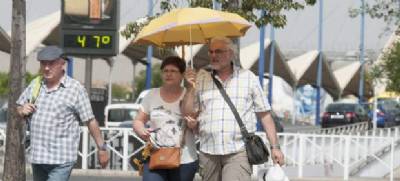
Heatstroke victim in hospital as Met office warns most of Spain will hit over 40ºC today
Heatstroke victim in hospital as Met office warns most of Spain will hit over 40ºC today
WEATHER warnings have been reinforced and health services are urging the public to take precautions as the temperature rises across Spain, particularly after a man from Toledo was admitted to intensive care with heatstroke yesterday (Sunday).
The 44-year-old collapsed in the street in Alameda de la Sagra in his home province and was unconscious when he was taken to hospital.
And it was not even the hottest part of the day at the time he passed out – the ambulance was called at 11.20hrs.
Because of Spain being an hour ahead of its geographically-correct time zone, and – like the rest of Europe and many other parts of the world – having put the clocks forward an hour for the spring, the midday or noon sun in fact comes at 14.00hrs.
But UV rays are not the only aspect health authorities are concerned with – the sheer heat as the mercury rockets to a typical 40ºC means dehydration is a risk, and prolonged exposure to high temperatures and bright sunshine without taking measures to cool down or drinking any water can put people in danger of suffering heatstroke.
This is a more serious condition than what is loosely referred to as 'sunstroke' or 'heat exhaustion' where the sufferer feels listless, headachey and nauseous – whilst these are also symptoms of heatstroke, the latter can also come with cold sweats, trembling, disorientation and confusion, and vomiting.
Heatstroke is extreme hyperthermia, when the body hits a temperature of around 40ºC.
The generally-accepted 'normal' body temperature is between 36.1ºC and 37.2ºC depending upon the person, with 38ºC considered to be a fever, and 40ºC or above being life-threatening.
At 40ºC or over, the internal organs can literally start to cook and are in danger of failure, and this is a medical emergency – coma and convulsions are likely at 42ºC and survival is difficult; cardio-respiratory collapse is very probable at 43ºC, which is generally considered practically impossible to survive.
Whilst a body temperature of 44ºC is said to mean 'certain death', a few cases of people surviving when their fever pitch goes up to 46.5ºC have been recorded.
But body temperature and what the mercury shows outside are unrelated: the difference in human body temperature between their 'feeling too hot' and 'feeling too cold' in summer or winter is typically only about 0.5ºC either way.
Still, the State meteorological agency, AEMET, says that with thermometers expected to sit at around 40ºC in practically the whole of the country and as high as 42ºC or 43ºC in Toledo, Sevilla and Córdoba, all steps should be taken to prevent heatstroke.
Constant fluid intake, with 'sports' drinks for anyone who is sweating heavily or has been undergoing even light physical activity highly recommended, regular cooling off by taking a dip in the pool or sea, or running chilled water over the wrists at least, wearing a hat and sunglasses, keeping out of direct sunlight in the middle of the day – or all day, if possible – and using a high-factor sun-cream are some of the health service's recommendations.
Caffeine and especially alcohol should be avoided, since both of these dehydrate the body.
At the slightest sign of being indisposed, especially in the case of children, the elderly or anyone suffering from an illness, medical services should be contacted.