Valencia's 'Fallas' fiesta earns UNESCO heritage status
Valencia's 'Fallas' fiesta earns UNESCO heritage status
VALENCIA'S noisy, fun and colourful Fallas festival has been given UNESCO heritage status, putting it on the world map, ensuring its lifelong protection and potentially bringing in even more tourists.
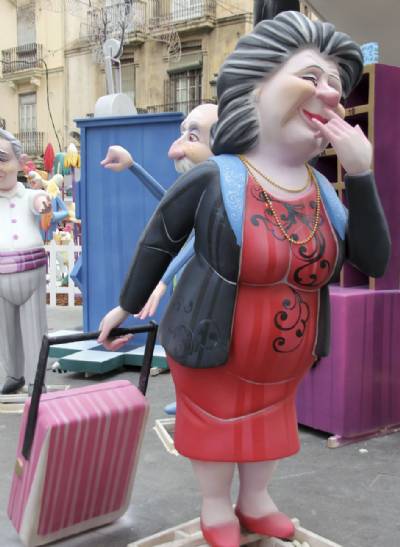
Every year in mid-March, papier mâché monuments the height of a small block of flats are set up at practically every junction in the city, featuring a number of scenes with caricatures of politicians and famous people, poking fun at current affairs.
The late Rita Barberá, mayoress for 24 years until May 2015 and who died from a heart attack in Madrid on November 23, has featured in falla monuments so often that she would have thought something had gone drastically wrong if she ever walked past one which didn't house a spoof statue of her – such as the one in the above picture, in her characteristic red suit jacket.
Fireworks go off, marquées or 'casales' are set up next to every monument – known individually as a falla – in which girls and boys in traditional Valencian costume, called falleras and falleros respectively spend the best part of a week partying, eating and drinking around the clock.
A wooden frame with the head of the Virgin Mary is set up and falleras place bunches of flowers in it until a giant floral Mother of Christ is formed.
Then, on the last night – March 19, which is Father's Day and Saint Joseph's Day in Spain – the fallas are burnt to the ground, starting with the lowest-placed in the prizegiving and ending with the winner.
The fallera queen gets to choose a statuette, or ninot, from her falla to save from the flames.
At 14.00 every day, a mascletà, or huge and ground-shaking display of colourful gunpowder bangers splits eardrums in the next province, and live music and parades take place whilst all other aspects of life in the city are put on hold until March 20.
Most other towns in the province of Valencia and a few in the north of that of Alicante and south of the province of Castellón also celebrate the Fallas, meaning residents rarely have to catch the train to Valencia city to soak up the festive atmosphere, although the main fiesta in the regional capital is arguably the biggest, best, most flamboyant, loudest, and most authentic.
The Fallas is to Valencia city and region as the Semana Santa Easter parades – celebrated in a lower-key manner in every town in Spain – and the Feria de Abril or April Fair are to Sevilla, and the pre-Lent Carnival is to the Canary Islands (and to Brazil), although the ritual caricature-burning, flower-offering and gunpowder-blasting fiesta is still only known to the discerning few outside of Spain.
That is all set to change: a UNESCO meeting in the Ethiopian capital of Addis Abeba this week approved Valencia's candidature for the Fallas to become 'intangible heritage'.
As well as the metropolitan area, this decision has a huge impact on the towns of Gandia, Sagunto, Utiel and Oliva (Valencia province) among others, plus Benicarló and La Vall d'Uixò (Castellón province) and Dénia and Pego (Alicante province) where the Fallas are celebrated, as well as parts of the Balearic Islands and even Argentina where Valencian exiles mark the festival.
To mark the success of the UNESCO application, a falla has been set up near the Serrano Towers in Valencia.