BEACHES may be abundant in Spain – and blue-flagged beaches more numerous than in any other country in the world – but, clearly, not every town has one. Yet one thing almost every town does seem to have, irrespective of its size, is a castle.
When thinking of castles, you'll probably picture a long list of other countries before Spain even enters your head – despite its having so many of them that a significant proportion have practically no information about them in circulation beyond the year, or decade, they were built, who built them, and who owned them.
For many residents in Spain, a view of a castle on a mountain from their window, or the image of one in the background on their walk to the local supermarket, is rather like wallpaper; they're so blasé about it that they probably fail to notice it 99% of the time.
Imagine having a castle-on-a-mountain view as you stroll around town on boring errands, and not even registering it. It's enough to make history-lovers, scenery-lovers and fairytale-lovers cry out in horror.
Fortresses were constructed all over the country during the Moorish era, when Spain's population was predominantly Arab, over around 700 years until about the time of the Catholic Reconquest in the late 15th century; mostly, they were defence or look-out points, but sometimes the whole town was based inside it – houses built into the inner walls – or the castle started as a central point with the town sprouting up around it, spreading outwards in a sort of circle over the next few centuries.
They were often the seat of rulers, the residence of a rich and powerful family, or a status symbol, or all three; many were renovated in a style to reflect the time of their renovation, meaning Renaissance, Baroque, Neo-Classical and even Modernist elements added, sometimes almost wiping out all trace of their original Mediaeval Islamic design. They could be used as 'currency' – ceded to an aristocratic figure in payment of a debt or in exchange for other land.
In the Civil War, they even became a useful site for building 'bunkers', or air-raid shelters – in Spain, huge public ones were constructed, rather than each individual household digging one in their garden (partly because a high number of town properties are apartments and do not have gardens).
And in more recent centuries, castles have ceased to become living quarters, their protective element is no longer needed, and thankfully, since the Civil War, have not been required as protection from bombs being dropped.
Which means the 'lucky' ones have become tourist attractions, benefiting from government funding to keep them in a good state, and the 'unlucky' ones have just been left to crumble.
Even these have their unique charm, though. Locals and visitors enjoy hiking up the hills to explore the ruins of an ancient castle and, on googling them and finding little more than whom they belonged to and the approximate time they were built, have the fun of imagining what they must have looked like in their heyday and what life was like at the time.
Castles, in summer, become venues for outdoor concerts, sometimes night ones, when they're romantically illuminated, and, as they provide shade from the burning sun, draw in holidaymakers seeking a little 'extra' to their beach breaks. Some town halls offer guided sunset or star-gazing tours of their hilltop castles, too.
Plus, of course, they're a brilliant reason in themselves to visit Spain in winter.
Whilst you're probably not far from some castle or another wherever you live or are staying in Spain, a handful of them are so breathtaking, elaborate and atmospheric that they've become famous way beyond their home countries – and for very good reason.
Maybe you've opted to shelve your holidays for winter this year. If so, a 'Spanish castle tour' could be an excellent way to spend them.
Let's take a look at some of the nation's favourite castles, hand-picked by tourism boards, tourists, travel writers and mainstream newspapers.
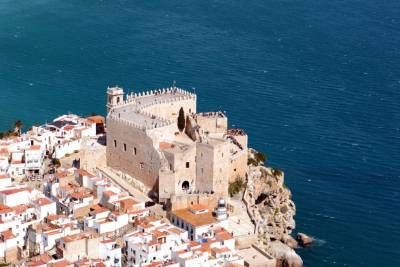
Peñíscola (Castellón province)
No need to even choose between 'beach' and 'castle' here. Based on what is known as the Costa del Azahar ('Orange-Blossom Coast' – for very obvious reasons, as you'll see in its landscape), the shores of Castellón province are very geared-up to national and international tourism, but there isn't a great deal of it. Just enough to give it some atmosphere, but largely undiscovered by Brits (or any other northern Europeans, for that matter), meaning it retains that perfect balance between being a lively holiday hotspot and unspoilt at the same time.
In fact, Peñíscola and its neighbouring coastal towns have been able to be, within reason, fairly relaxed about restrictions and rules for beach use this summer in light of the pandemic, because overcrowding, even at peak holiday times, is very rare.
Built between 1294 and 1307 by the Knights Templar – one of the most powerful Christian Orders in the Middle Ages – Peñíscola castle is in the minority insofar as it differs from the prolific Islamic castles seen throughout most of the mainland.
It was once, even, a Papal seat – Pope Benedict XIII, born Pedro Martínez de Luna y Pérez de Gotor in Illueca, Zaragoza province, in 1328, and known in Spain as Papa Luna, lived there for a time, and was in fact still there when he died in 1423.
Peñíscola castle sits on a rocky hillside right next to the beach, so you can admire it while you soak up the rays. (Photograph by the provincial government, or Diputación de Castellón).
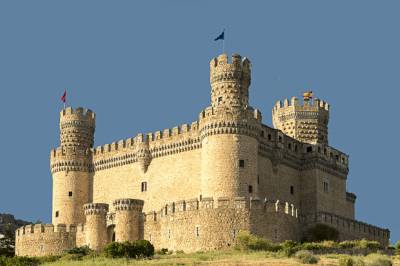
Manzanares el Real (Madrid)
You want to escape cities in summer, don't you, not actually travel to them for your holidays? Well, if you've toured around Spain a bit, you may have noticed how its cities seem to just 'stop'. Literally five kilometres, or fewer, outside a heaving metropolis, you typically find yourself in empty countryside without a building in sight. Indeed, that's why the Costa Blanca holiday capital of Benidorm is popular with visitors who are seeking the exact opposite of everything 'Benidorm': You can find excellent-quality, cheap accommodation, and then spend your entire break about five minutes by car outside it. Beyond its boundaries, even a kilometre beyond its boundaries, you're in 'real Spain' with quaint villages, historical towns, predominantly-Spanish residents and shops, and beautiful mountainous landscape.
Ditto Madrid – despite being a capital city, its outskirts are open countryside dotted with little villages and satellite towns with urbanisations and swimming pools, plus mountains and ski resorts. The Sierra de Madrid is a popular winter and summer getaway for that reason, and this is where we find Manzanares el Real and its spectacular castle.
If ever a building were to make you stop in your tracks with an instinctive 'wow', this is it: Built in the 15th century (nobody is sure exactly at what point), its structure is an attractive fusion of the European Romanesque and the uniquely-Spanish Mudéjar, an architectural style that evolved among the community of Moriscos, or Muslims who had converted to Christianity to avoid being thrown out during the Inquisition. Moriscos were tolerated, rather than accepted, and considered second-class citizens, so they were generally poorer and could not afford high-quality building materials for their homes and monuments; they had to 'make do' with bricks, wood and mud. What they actually created with this impoverished source of parts ended up being some of the most beautiful, even majestic-looking, architecture in Spain.
Manzanares el Real castle was commissioned initially as the home of the House of Mendoza, one of the most influential dynasties in what used to be the Kingdom of Castilla in the late Mediaeval era and early Renaissance, and has since been restored multiple times, meaning it is in an excellent condition with practically no signs of ruin.
Inside, its vast collection of tapestries, paintings, furniture and armoury dating from the 16th to the 19th century are almost as splendid as the building itself. (Photograph by Madrid regional tourism board).
So, after Manzanares el Real, you think you've been spoiled for every other castle in the world you see; no matter how spectacular, you know nothing will match up, leaving you disappointed.
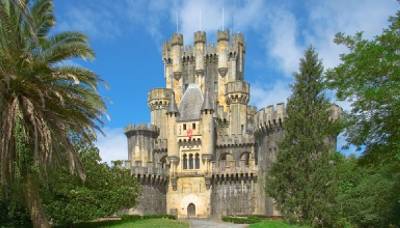
Enter Butrón Castle in the Basque town of Gatica, in the province whose capital is Bilbao (another location where you don't have to choose between castle and beach). First of all, you'll check Google Maps on your phone to make sure you haven't lost your way and ended up in Disneyland Paris; no, this haunting creation came long before the theme park version. Straight out of the pages of a classic fairytale, or perhaps a gothic novel, it originally went up in the Mediaeval period, but its current appearance is almost entirely due to a complete renovation carried out in the 19th century by the Marquis Francisco de Cubas, an architect as well as an aristocrat.
He remodelled the fortress mainly for pleasure and to turn it into a visual attraction that may, if needed, be used for 'some other purpose', undefined; in fact, it was said to be very uncomfortable as a place to live in because its towers have limited useful space and some of its rooms are connected to each other via stairwells, bridges and corridors open to the elements.
As a bonus, it sits inside a park which is home to both native and exotic species of plants, although this is now largely abandoned.
For a short while, it served as a Mediaeval-themed restaurant, but was later embargoed and auctioned off.
Whilst currently a tourist attraction, it is reported to be up for sale, although the price is not widely known and is likely to be 'upon application'. (Photograph by the Basque Country regional tourism board).
Ponferrada (León province)
The centre-northern region of Castilla y León is a perfect summer destination for those seeking to escape the heat and humidity of the coast; in winter, it's one of the coldest parts of mainland Spain (much, much colder than the coldest part of a British winter), where thick snow even at sea-level is regular. But like most areas in Spain that experience exceptionally cold winters, the homes and hotels are built with this in mind, with central heating as standard, rather than on the Mediterranean and in the south where properties rarely have this as a feature, since it is not cost-effective given the short amount of time in the year it would be in use.
Castilla y León is home to the picturesque Duero river and wine region of the same name, as well as true architectural splendour and classical history: The ancient walled city of Ávila, the gigantic Roman aqueduct in Segovia, the 'Oxford of Spain', Salamanca, whose university was the country's first, and Burgos' elaborate, awe-inspiring cathedral (but don't ever visit it, because this really will spoil every other cathedral in the world for you, as you'll always be comparing them all unfavourably to Burgos).
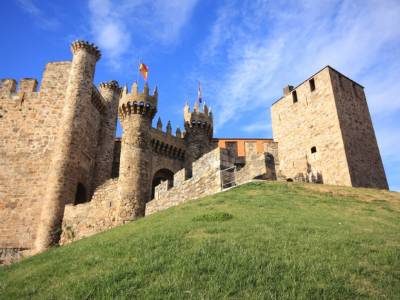
And also Ponferrada castle, in the town of the same name in the El Bierzo district – another one built by the Knights Templar, with the first few bricks laid in the year 1187 at the behest of King Fernando II of León, so with similarities to Peñíscola, but with a major difference: It is thought to have been constructed on the site of an ancient Celtic settlement.
This cultural movement – rather than a race or ethnic – shared languages of similar roots and originated in the Iron Age; its influences are heavy in Wales, Scotland, the English county of Cornwall, Ireland, Brittany in France, and also, in northern and north-western Spain and Portugal. Indeed, traditional music, costume and dance from Spain's northern regions and from most of Portugal has a strong Celtic feel, and melodies that, to the layperson, sound 'almost Welsh or Irish' frequently creep into even modern-day pop and rock music in the charts performed by artists who come from these regions.
The Celtic influence remains strong in Ponferrada castle, even though it was largely reconstructed in the 1340s after King Alfonso XI donated it to the aristocrat who was his head butler, Pedro Fernández de Castro, when it became the seat of power of the Castro dynasty for the next 34 years.
Since then, it changed hands several times between successive Royal and noble families, including that of Pedro Álvarez Osorio, first Count of Lemos, in 1440, until about 1850 when it fell from grace and began to be plundered by the town council for building materials and its land used for grazing and even a football pitch.
Luckily, its declaration as a National Monument in 1924 gave it heritage status and protection, stopping it deteriorating any further and opening it to tourists. (Photograph by Ponferrada council).
Alcázar of Segovia
Now for the jewel in our castle crown. If Germany's Neuschwanstein Castle is on your travel list, but you're a bit reluctant to leave Spain at the moment with the pandemic, the Alcázar, or 'fortress' in Segovia is a great alternative. Like something out of Grimms' fairytales, this architectural treasure is possibly one of Spain's oldest, as it began life as a Roman settlement, then went on to become a Mediaeval castle, a Royal palace, a 'strongroom' for the Crown treasures, a State prison, the Royal Artillery College, and the General Military Archive.
The word alcázar comes from the Arabic alqasr, which describes a fortified Royal residence, and was entered for the first time in the Spanish dictionary in 1870 defined as 'the ancient name for the palaces of Kings and great lords, because they were all powerful'.
If you find you can picture Cinderella standing at its windows gazing out longingly as her Ugly Sisters trot off to Prince Charming's ball without her, you won't be far off the mark: Walt Disney was reportedly inspired by the Alcázar in Segovia when designing the castle featured in his screen version of the tale.
And Orson Welles used it his 1965 Shakespearean adaptation, Falstaff.
The Alcázar was an Islamic fortress originally, set up on the site of a 2,000-year-old Roman villa, remains of which still exist, and the earliest confirmed information about the structure dates back to 1122, soon after King Alfonso VI of León reconquered the city.
It's now one of Europe's favourite tourist attractions.
We've already mentioned Segovia and its Roman aqueduct – and this, along with the Alcázar, is what has led to the Castilla y León city's becoming one of Spain's 15 municipalities which are, in their entirety, UNESCO heritage sites.
The Alcázar is shown in the first photograph above, from its own website, Alcazardesegovia.com.