8 min read
Spain's mainland Mediterranean coast is where some of the best beaches, warmest weather, greatest choice of homes for sale and most diverse mix of nationalities are found. The Costa Blanca, about halfway down this coast, encompasses the entire shoreline of the province of Alicante and a few kilometres inland from it. It's one of Europe's favourite destinations: Holidaymakers and foreign residents have been visiting, returning to and settling there for generations.
When deciding on the best Costa Blanca location to move to, it helps to know which areas are most suitable for your chosen lifestyle.

The Costa Blanca's split personality
In reality, there are two Costa Blancas. Whilst not their official titles and never referred to as such in Spanish, expatriates of various nationalities have been identifying their part of the coast as North Costa Blanca and South Costa Blanca for decades. Those who live in one half, after visiting the other for the first time, are stunned at the contrast and struggle to believe they're both in the same province.
The invisible border invented by foreign residents is broadly considered to be just north of the Alicante metropolitan area, known as the Campo de Alicante or L'Alacantí. The North takes in the districts of the Marina Baixa, which backs onto the metropolitan zone, and the Marina Alta, which finishes where Valencia province starts. Alicante city, and everything between it and the next region, Murcia, is the South. This includes the Vega Baja del Segura district and the Baix Vinalopó.
North and South Costa Blanca: What's the difference?
As a general rule, the farther south along the Costa you travel, the greater the expat influence and presence is. Whilst the far north of the coast remains much more unspoilt and 'traditionally Spanish', the far south is comprised of large urbanisations, or residential complexes, occupied almost exclusively by northern Europeans. The main differences are:
- South Costa Blanca expatriates are generally – although, of course, not always – less integrated, since they are heavily clustered together and have limited contact with the local Spanish community. North Costa Blanca expatriates live in or close to small towns and villages, and are more thinly spread, so they interact more with Spaniards.
- Foreigners on the Costa Blanca South are more likely to be part-time expatriates, spending several months per year in their holiday homes, whereas foreigners of many years' or decades' permanent residence are the majority on the Costa Blanca North.
- In the southern half, the dominant, and often only, language among locals is Spanish, whilst in the northern half, Spanish coexists with or even takes a back seat to the co-official regional tongue, valenciano.
- The North Costa Blancais greener, more mountainous, forested and rugged, and the South Costa Blanca drier, flatter and more desert-like.
Similarities between the North and South Costa Blanca
The 'two Costa Blancas' do have points in common, though, namely:
- Infrastructure, services and facilities for residents and holidaymakers, both Spanish and international, are similarly well-established anywhere along the Costa, although there are more expatriate-run or multi-lingual services – especially English- or German-speaking – in the south.
- There is no real north-south divide in terms of property prices. Budget and luxury homes and plenty between the two can be found in much the same proportion to each other in either, although ultra-high end properties worth millions are more widely available in the north.
- Both north and south have plenty of professional-standard golf courses and international schools, although they are more widely scattered in the north. On the South Costa Blanca, you'll find several concentrated in one or two local areas.
- Pristine urban beaches abound along the entire coast, although quieter, more rural beaches are easier to find in the north. As a bonus, Alicante is the province in Spain with the most blue-flagged beaches – in a country which already has more of these than any other nation on earth.
Why the South Costa Blanca?
This part of the coast is most suited to you if you're looking for:
- A neighbourhood that feels like a holiday resort
- Large expatriate communities to live among
- A social life without having to speak Spanish (although you will need to learn itfor everything else)
- Services and facilities mostly run by, and for, foreign residents
Not all the South Costa Blanca fits this profile, however. If you prefer to avoid the above factors, but want or need most of the following, you can still find a suitable location:
- Local 18-hole golf courses
- International schools
- At least two airports you can get to quickly (Alicante-Elche and Murcia-Corvera)
- Nearby motorways or major trunk roads
- A highly built-up area, or in or close to a big town or city
- A lively holiday feel in summer, but peace and quiet the rest of the year
- A huge choice of homes for sale or rent at competitive prices
Torrevieja and Orihuela area (Vega Baja)
Starting from the southern border of the Costa Blanca in the district known as the Vega Baja del Segura, its two largest municipalities are home to the biggest concentrations of northern European – especially British – expatriates in Spain.
Torrevieja
A bustling port town of 90,000 people, and the closest to most urbanisations for supermarket shopping, medical appointments, leisurely day trips, and country walks. Attractions include five urban beaches, a lively esplanade market, abundant restaurants, a buoyant summer nightlife and arts scene,museums, and the vast salt-marsh nature reserve of La Mata. Torrevieja is fairly well connected, with a national-lines coach station, the A-7 motorway about 10 minutes away, Alicante-Elche airport within a 40-minute drive or 50-minute shuttle-bus ride, and Murcia-Corvera airport 45 minutes away by car. It has no rail station – the nearest is in Alicante city, 50 kilometres to the north.
Orihuela
The Vega Baja's richly-historical and agricultural district capital, its population size is similar to Torrevieja's, but much more widely distributed. The enormous municipal territory covers 22 tied villages, extensive farmland, eight mountain ranges, and 57 urbanisations onseven beaches. The town proper is 30 kilometres inland from its coastal hub, Orihuela Costa, which is made up entirely of purpose-built residential complexes and is home to around a third of Orihuela's total headcount. Over three-quarters of Orihuela Costa's inhabitants are foreigners, mainly British and German.
Whilst both Orihuela and Torrevieja retain much of the essence of classical Spain, the vast majority of expatriates in their wider area and neighbouring towns live on urbanisations. A sea of close-coupled white and pastel-coloured villas, terraces and apartments, most with access to swimming pools, stretches over 35 kilometres along the coast. A combination of holiday homes and year-round residences in almost equal proportion, barely 4% of the population in these complexes is Spanish: Over two-thirds are British, and roughly a quarter are German.
Just north of Torrevieja, a quarter of residents in Guardamar del Segura are non-Spanish Europeans, of whom over half are British. Foreigners and Spaniards are split 50-50 among the 3,500 living in Benijófar. Here, around 900 are British, or 26%, far outnumbering the 60 Germans who represent its second-largest expatriate community. In Benijófar's neighbour, Rojales, the expatriate presence is greater still: Over 70% of inhabitants live on the urbanisation Ciudad Quesada, where practically the entire headcount is foreign and three-quarters of it are British. In fact, more UK nationals live in Ciudad Quesada than in any other municipality in Spain.
These urbanisations are largely self-sufficient in terms of practical and leisure facilities like basic medical and banking services, shops and bars, plus an international schoolin Villamartín. They share seven 18-hole golf courses, including those in Campoamor, Villamartin, Algorfa, and Ciudad Quesada.
Popular expatriate urbanisations
Nearly 100 urbanisations in seven towns alone are occupied almost exclusively by expatriates, so these are just a few examples:
- Orihuela Costa: La Zenia, Dehesa de Campoamor, Punta Prima, Cabo Roig, Playa Flamenca
- San Miguel de Salinas: Villamartín, Eagle's Nest, Blue Lagoon
- Pilar de la Horadada: El Mojón (shared with Murcia), Campoverde, Mil Palmeras

Elche and Santa Pola area (Baix Vinalopó)
Directly north-west of the Vega Baja is the district known as El Baix Vinalopó, comprising the city of Elche and the two smaller towns of Crevillente and Santa Pola. Only Santa Pola is right on the coast; Elche has nine beaches, but the nearest of these is 15 kilometres away from the actual city.
Unlike the Vega Baja, Spaniards are very much in the majority, and the expatriate population in all three towns is a diverse multi-national mix. Santa Pola is the most cosmopolitan: Of its 21% of non-Spanish residents, a third are from outside Europe. In Crevillente, nine in 10 are Spanish, and only a quarter of the rest are European.
Crevillente
Picturesque and rural, Crevillente is surrounded by nature reserves, mountains and salt flats, yet extremely well connected, being right on top of a motorway and two major inter-provincial highways. As it's exactly halfway between Alicante-Elche airport and the coast (23 kilometres to either), and almost walking distance from Elche city, Crevillente is a highly-practical location for expatriates.
Elche
Despite being the second-largest city in the province of Alicante, just 14 kilometres from the airport, and served by major highways, Elche is exceptionally green. Its UNESCO-endorsed palm-tree forest is the biggest on earth outside the Arabian peninsula. An élite worldwide shoe-manufacturing industry, a university, two international schools, and a bilingual infant school are evidence of Elche's open, global outlook. It is, however, very much a 'working city' rather than a summer holiday destination. Elche's expatriates come from every continent, typically speak Spanish, and are integrated into the community.
Nearly everyone living full time in Elche's satellite coastal residential hubs is foreign - mainly British and French - because most properties are Spanish-owned holiday homes and empty 10 months of the year. Arenales del Sol, which is high-rise and fast-growing, and La Marina, which is semi-rural and low-density, each have a year-round population of roughly 2,500. This multiplies tenfold when families from Elche city move in for the summer.
Santa Pola
European expatriates here mostly settle in out-of-town urbanisations, such as Gran Alacant, although a few live in beach-side neighbourhoods that are practically deserted from September to June. Here, apartments are used by locals solely as summer homes, often owned by the same families who bought them brand-new in the 1960s, and are among the cheapest seafront properties on the Costa. Beach homes are rarely a budget option, but these are five-storey blocks with no lifts and considered 'old' by Spanish standards, making them a real bargain.
Gran Alacant is more expensive, since its hilltop location backs onto a protected nature reserve, but always well occupied: It has enough high-street amenities for year-round living, even a school. Some properties are Spanish-owned holiday homes, but most residents are British, French, German and Italian.
Alicante city and outskirts
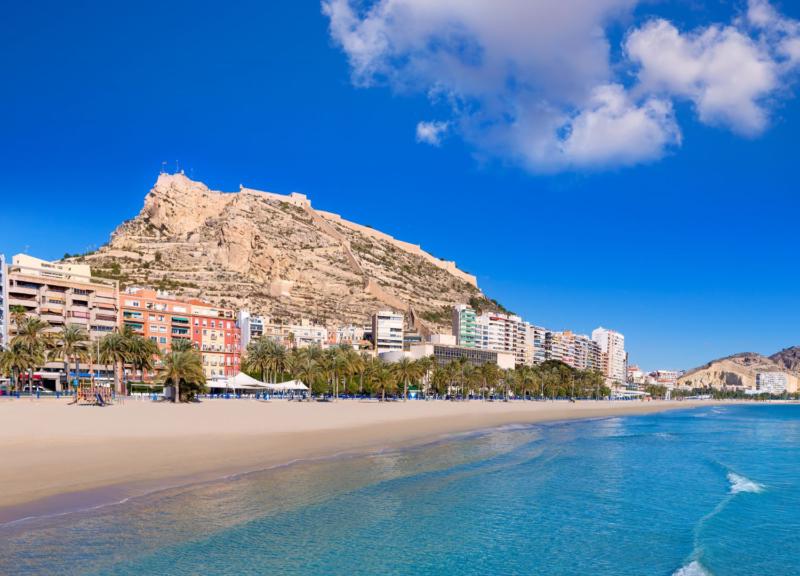
Capital of its province and home to approximately 360,000, Alicante is one of those privileged cities where department store and office-block workers can spend their lunch hour on the beach. The blue-flagged El Postiguet is barely 10 minutes on foot from the main commercial core of the metropolis, and the seafront esplanade flows neatly onto Spain's longest motorway. Flanked by high-rise hotels, the wide and inviting palm-lined promenade is the nerve centre of Alicante's summer holiday heartland.
Once you get off the beachfront Alicante is a functional city, but it's highly cosmopolitan. Daily ferry connections to Morocco and Algeria, a major coach and rail station, an airport eight kilometres away, and Alicante University in the suburb of San Vicente del Raspeig – where an abundance of small flats at relatively low prices can be found to rent, buy, or buy to let – attract residents from all over the world.
Three international schools cater for multi-lingual families: A French Lycée in the suburb of El Campello and, in the city itself, a British-curriculum school and a European centre which gives lessons in French, Spanish, English and German.
Ideal for golf lovers, the city and outskirts have three courses. El Plantillo and Alicante Golf resorts, and Bonalba in nearby Mutxamel, are a short distance from the motorway, city centre, and Elche and Crevillente.
Villas close to Bonalba are around 30% cheaper than similar properties nearer the city, making Mutxamel ideal for a quieter life and luxury on a reduced budget. Most European expatriates either live there, or on San Juan beach, which is shared between Alicante city and El Campello.
If you think the South Costa Blanca is for you, try our Find Your Place in Spain tool that lets you select the area and filter for lifestyle needs and choices – even for proximity to expatriate communities.

Last updated: 23/09/2025
Was this article useful?
Related Topics
Related Articles