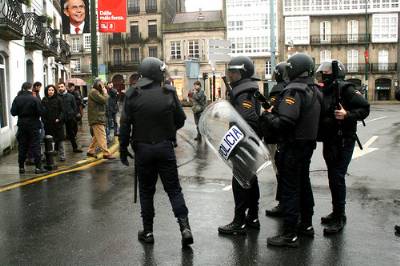
Photographing police not a crime unless security is at risk, government clarifies
Photographing police not a crime unless security is at risk, government clarifies
SPAIN'S socialist government has started work in earnest on reforming the Public Safety Law of 2015 – known colloquially as the 'gagging law' – and, until its overhaul is complete, has opted to set guidelines for interpreting each of its more controversial aspects.
The PSOE and its main supporter, Podemos, want to erase those parts that prevent freedom of expression, including the right to protest without facing prohibitive fines ranging from €30,000 to €600,000.
Its first move has been to relax the clause that threatens massive fines for photographing or videoing the police in the course of their duty.
Ostensibly to prevent police officers' 'privacy' from being infringed by their being identified on social media, and to avoid obstructing the course of the law, the photographing and videoing ban effectively means that if anyone has issues with police action, they cannot gather or produce evidence and are likely to lose their case.
Also, innocent snaps of unusual and quirky situations – such as taking a picture of police on quad bikes for one's personal collection, or even acquiring stock pictures of officers on patrol for illustration – are grey areas which could, in theory, lead to a fine.
But Spain's interior ministry has now decreed that it is not an offence to video or photograph a police officer in the course of duty as long as this is not a security threat.
Provided doing so does not 'represent a risk or danger' for the officer or officers in question, their family, their operations or their facilities and infrastructure, it is not a criminal offence, the ministry clarifies.
The only time it would be is where 'extreme risk' is present.
Where no immediate danger to the officer or operations exists, officers are not permitted to confiscate mobile phones, cameras or video cameras and destroy footage, as they have been able to do since 2015 – effectively leaving members of the public defenceless if they are trying to gather evidence of excessive force used in demonstrations.
Police have criticised the move, and even more so the fact they were 'not consulted' before the clause was reinterpreted.