
DIG below the surface of the migration drama and an abundance of 'rags-to-riches' tales begin to come to light. Or not 'riches', necessarily – at least, only in comparative terms for desperate emigrants who expect very little beyond survival and the ability to keep their families safe from starvation, or worse.
We've already recounted the tale of 'Spiderman Samba', a Mali migrant whose story in Spain began with climbing the border fence into the north African Spanish-owned city of Ceuta, months in a detention centre for 'illegal immigrants', and now, many years in a stable job packing fruit in a Murcia warehouse before becoming a local hero when he saved the life of a woman with Alzheimer's trying to climb out of a second-storey window.
In the same story, we spoke of Gorgui, now 21, from Gandia (Valencia province), whose life changed when he rescued a wheelchair-bound man from the fourth floor of a burning block in Dénia: Being given a residence permit for himself, his wife and baby daughter as a 'reward' means he was able to look forward to training as a lorry driver and being able to afford to rent a flat for the family, rather than a single room in an already-overcrowded apartment.
Now he has been given Spanish citizenship on the grounds of 'public interest', Gorgui is getting more ambitious: He has decided to study hard and train to be a fireman. After all, if you can scale four floors and carry a grown man and his dog to safety over your shoulder in a matter of seconds, with no equipment, before setting off home on the bus, your vocation is probably screaming at you to embrace it and follow it.
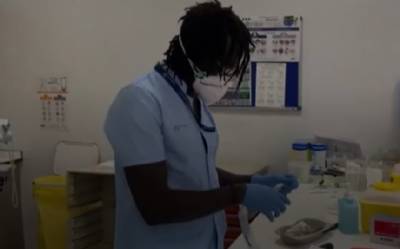
Mbaye, from Sénégal, is one of the health service workers you were clapping for at 20.00 every night during lockdown. He's just 30, and already has a key public rôle, a stable job with a living wage and a public-sector contract and pension – the Holy Grail of hundreds of thousands of Spaniards of a similar age.
And he came over on an overstacked inflatable dinghy, not knowing what he was going to find, or even if he'd make it here alive.
“The dinghy trip is like that – either you get there, or you die, it's that simple,” says Mbaye.
For that reason, he knew his parents would never, ever have let him board the boat, so at age 15, he sneaked out of his home without telling them.
As the craft docked in Tenerife, a teenage Mbaye, freezing cold, dehydrated and suffering malnutrition, suddenly started asking himself for the first time, “what's going to become of me now?”
'I want to do this one day'
He hadn't expected to survive, and goes quiet when remembering many others on board who lost their lives en route, whom he watched perish either in the sea or from exposure, hunger and thirst on the craft; something that, he now knows, happens to hundreds of others every year.
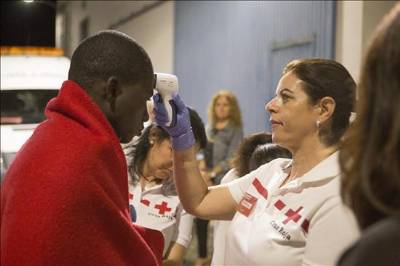
Through his crippling anxiety and cold fear, Mbaye remembers Red Cross paramedics attending to him on the shore, and how he thought at the time, 'I want to be doing this one day'.
Another lifetime stretched before Mbaye before he was able to realise his potential.
Unable to speak a word of Spanish, taking cash-in-hand day-jobs picking fruit or unloading kept him in the bare minimum of food, and he worked from sun-up to sundown, seven days a week, selling cheap souvenirs on the street.
He was one of thousands who became what used to be known as a 'looky-looky man', and who swiftly have to learn the ropes: Pressuring members of the public or intruding when they are having a quiet drink will get you nowhere; if they want to buy, they'll buy, immediately, and if they show the slightest sign of not being interested, you move on quickly.
And you learn to be quick at disappearing when necessary.
“There's a lot of police persecution,” says Mbaye.
“I ended up arrested three times.”
Street-hawking remains illegal in Spain, and although authorities often turn a blind eye – on the basis that the sellers are not doing any harm, merely trying to feed themselves, and will never be earning enough to qualify for paying taxes anyway – they often don't, and sellers find out the hard way when they mistakenly try to sell knock-off designer goods, discovering when they have their haul confiscated and end up fined, behind bars, or both, that this is a criminal offence.
Mbaye said his sales of socks, keyrings and cheap jewellery did not earn him enough to put a roof over his head for a long time.
“I was sleeping rough, on the streets,” he explains, pointing out a bridge in his home city beneath which he often used to crash for the night.
Eventually, he saved up enough to move into a shared apartment, where others in his situation lived cramped up together in poor conditions; but it was a comfortable alternative to the pavement in all weathers.
And as well as trying to eat, he also had to pay off a debt of €4,500 to the mafia-style organisation which had shipped him to the Canary Islands.
Although this would have been plenty enough for him to apply for a passport and book a flight to Spain, there would have been no point in presenting himself to authorities upon arrival to request asylum; Sénégal is gripped with extreme poverty, but is not war-torn or under a violent political dictatorship, so he would not have qualified for refugee status.
Mbaye had worked his way across Spain in the meantime, although at the time he had paid off his debt, he was still under 18, meaning he was young enough to be adopted.
His new family sent him to school, where he thrived; he made it to college, and studied to be a nurse.
Now, aged 30, he has been working for the past few years as a nurse at the district hospital in Basurto, near Bilbao in the Basque Country – completely the opposite end of Spain from where he started – and has, more recently, been putting his life at risk once again, caring for patients with Covid-19.
A vocation which he was determined to make his own from the moment he stumbled out of the dinghy in Tenerife and was treated by the medical team already stationed there after being alerted of the arrival of his craft.
'Essential services'
'Illegal immigrants' are costly to the State, in economic and public health terms, but the simple act of giving them at least a temporary residence permit can mean, instead, the public coffers earn up to €1.5 billion a year extra, argues Spain's deputy president Pablo Iglesias, leader of the left-wing party Podemos.
An estimated 600,000 people live in an 'undocumented' state in Spain – of whom 100,000 are waiting to hear about their asylum applications – outnumbering the British diaspora in the country by 50%.
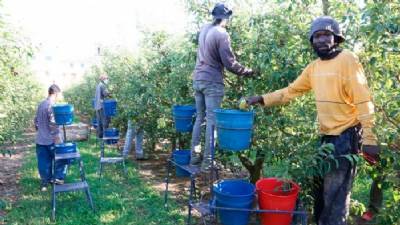
And many of them – those on temporary visas and even those with no papers at all - were working 'underground', harvesting fruit and vegetables, driving and delivering, cleaning and disinfecting, and some actually in hospitals, as porters, cleaners, and fetchers-and-carriers, Iglesias argues.
Give them residence, and these jobs can become 'official', meaning they can pay taxes, their employers can pay Social Security (national insurance) on their behalf, and everyone benefits, Iglesias says.
Also, the Podemos leader points out, any 'illegal immigrant' who experiences symptoms compatible with Covid-19 or, indeed, any other contagious or infectious condition, is very unlikely to seek medical help, even though they would be given it, because they were terrified of being deported.
This in itself creates a public health risk which could be countered by removing the deportation fear.
Iglesias says those on temporary visas who were working in key support rôles during lockdown, many of whom continue to do so as the pandemic continues, should be offered permanent residence or even Spanish citizenship.
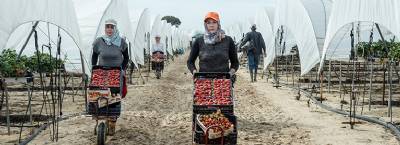
He said at the time of this proposal that he was sceptical as to whether his socialist (PSOE) coalition partners would agree to it, but a Royal Decree, or Bill of Law that has just come into force now provides for all undocumented third-country migrants working in the farming sector to be given a two-year residence and work permit, which can then be extended for another two.
By the end of these four years, if they are in stable work – self-employed or employed – the idea is that they would probably qualify for permanent residence, normally granted after five years.
Initially, the government is allowing third-country migrants whose work permits were due to expire prior to June 30 to renew these automatically, along with those whose permits were still valid and who were aged between 18 and 21.
The aim is to 'provide legal security to these young people who, with their work, are contributing to sustaining an essential industry at a difficult time for the country'.
They have until October 30 to apply, and will qualify if the work they have been carrying out was considered part of an 'essential service' between April 9 and September 30 this year.
It is expected to cover those farm workers taken on for temporary fruit-picking jobs on a short-term visa to keep the food industry in full supply during the pandemic.
And it it not just a left-wing idea: Earlier this year, Madrid-based MP Pepe Aniorte (PP) said he believed refugees and so-called 'illegal migrants' who had entered the country could be an asset to those parts of Spain suffering from an exodus of young people, taking on unskilled manual labour which would 'provide a great social benefit' to the empty rural provinces.
Aniorte says it is not always the case that migrants have limited schooling.
“In the case of refugees from Venezuela, for example, 80% of them are easily integrated in society and the job market, because they come with a very high level of education and their socio-economic background means it is not at all hard for them to blend in,” he explains.
He says Madrid's 'emergency attention service', for refugees and migrants in general, is 'the strongest and soundest of any other European city'.
Photograph 3, of Mbaye, from a screen-shot taken by Basurto hospital
Photographs 4 and 5 by the Unión de Pequeños Agricultores y Ganaderos (Small Arable and Livestock Farmers' Union, or UPA)